Gokyo Renjo Pass Trek Cost
Our standard 14-day Gokyo Renjo Pass Trek costs USD 1390 per person. It covers all logistics and services throughout the trek, including accommodation, airport transfers, meals, permits, guides, porters, and domestic airfare.
The package includes 3-star accommodation in Kathmandu and local teahouses on the trek. While the teahouses in the lower regions are well-equipped, the upper sections offer basic amenities and limited options. In Kathmandu, the hotel stay includes breakfast only, whereas all three meals are provided on the trek.
The package includes two-way domestic flights between Kathmandu and Lukla. A large portion of the fees covers the daily wages and salary of senior guides, porters, and support staff who handle navigation, luggage transport, and safety support during the trek. Besides that, it funds their critical operational expenses, including safety equipment, emergency preparedness, and travel insurance.
Note that the package does not include your two-way international flights, visa fees, travel insurance, personal expenses, or tips. The price can also vary depending on trek duration, season, group size, transportation, and service level. If you’re planning the trek in a large group, we offer a special discount of up to $150 per person, based on the group size.
You can also upgrade this standard package to a premium option for a comfortable and luxurious experience. In the premium package, the local teahouses will be upgraded to high-end mountain lodges (wherever available) with ensuite bathrooms, hot showers, electric blankets, and complimentary Wi-Fi. Moreover, you also have the option to upgrade your two-way flights between Kathmandu and Lukla to a premium helicopter option.
Please get in touch with us with your special requirements, group size, budget range, and preferred travel dates to request a customized package tailored to your comfort level.
Gokyo Renjo Pass Trekking Permit
You need to obtain the Khumbu Pasang Lhamu Rural Municipality Permit and the Sagarmatha National Park Permit for the Gokyo Renjo Pass Trek. Both these permits are mandatory and non-negotiable to trek in the Everest region.
Khumbu Pasang Lhamu Rural Municipality Permit
The Khumbu Pasang Lhamu Rural Municipality Permit is a new regulatory requirement to enter the Everest region. It was introduced in 2018 by the local government of Khumbu, replacing the traditional TIMS Card in the area. The fees collected from this permit are used for regional infrastructure development, including trail maintenance and repair of suspension bridges.
Where can you get the Khumbu Pasang Lhamu Rural Municipality Permit?
You can get this permit at the Khumbu Pasang Lhamu Rural Municipality Office in Lukla or the Monjo Checkpoint. This permit costs $20 per trekker, regardless of nationality.
Sagarmatha National Park Permit
Since the Gokyo Renjo Pass Trek passes through Sagarmatha National Park, you must acquire a valid park entry permit. Protected as a UNESCO World Heritage Site, Sagarmatha National Park is home to the world’s highest mountains, glaciers, deep valleys, and elusive wildlife. The fees collected from this permit are used to protect the fragile alpine ecosystem and the endangered species of the region.
Where can you get the Sagarmatha National Park permit?
You can get the Sagarmatha National Park permit at the Nepal Tourism Board Office in Kathmandu or Monjo Checkpoint. This permit costs $30 for non-SAARC Nationals and $15 for SAARC Nationals.
Best Time for Gokyo Renjo Pass Trek in Nepal
Like most trekking regions in Nepal, the autumn and spring seasons bring the best of the Gokyo Renjo La Pass Trek. These months are regarded as the peak trekking seasons in the Everest region, delivering the most favorable conditions for this high-altitude adventure.
Autumn (September to November)
Autumn is often considered the best trekking season in Nepal. The post-monsoon atmosphere brings dry and stable weather, ideal for high-altitude treks.
Unlike other seasons, the autumn skies almost certainly remain clear throughout the day. The clear visibility makes this the most popular season among mountain lovers and photographers. With minimal precipitation and well-defined trails, these months also provide reliable and safer conditions for crossing Renjo Pass at 5,345 meters.
The daytime temperature in autumn ranges from 10 to 16 degrees, while the nighttime temperature can plunge from 0 to -10 degrees. October is often considered the sweet spot as it combines excellent weather, clear mountain visibility, and a festive atmosphere across the country.
However, the finest trekking conditions bring an outrageous number of trekkers during autumn. The trails and teahouses are often packed with trekkers from around the world during these months.
Spring (March to May)
Spring is another exceptional time for the Gokyo Renjo Pass Trek. These months combine crisp mountain views, blooming wildflowers, and mild temperatures. During spring, the lower section of the trek is often adorned with varieties of wild flora, including rhododendron, orchids, birch, and pines. Hence, this is the favorite time of the year for bloom chasers and nature enthusiasts.
Spring temperatures are comparable to autumn temperatures, but slightly warmer. The daytime remains warm with temperatures ranging from 15 to 20 degrees, while the nights are often frigid with temperatures ranging from 2 to -7 degrees. The spring morning typically brings crisp and clear skies with impressive mountain scenery. However, the mountains usually hide behind thick cloud cover in the afternoons.
With longer daylight hours, you can move at a steady pace and tackle challenging sections safely during the spring season. However, we strongly recommend starting early for Gokyo Ri and Renjo Pass to avoid sudden changes in the weather.
After autumn, the spring season brings the second-highest number of trekkers in the Everest region. So, prepare yourself for massive traffic and crowded teahouses during these months. Additionally, the changing weather patterns may also cause occasional delays and cancellations to Lukla flights.
Winter (December to February)
Winter is not recommended for the Gokyo Renjo Pass Trek, especially for beginners. It is because these months bring extreme conditions for high-altitude trekking, including heavy snowfall, strong winds, blistering cold, and occasional snowstorms.
January, in particular, is the coldest month with the average temperature ranging from 4 to -25 degrees. The route across Renjo Pass may be entirely blocked during this month due to heavy snowfall. Besides that, these extreme conditions pose a high risk of hypothermia, altitude sickness, snow blindness, and sunburn.
If you’re willing to brave the cold, the early weeks of December and the latter part of February offer manageable conditions. That being said, winter trekking above 5,000 meters demands high experience and proper cold-weather gear.
Remember, extreme challenges often bring the greatest rewards. In winter, the skies remain crystal clear, offering postcard-perfect views of snow-covered peaks against bright blue skies. Moreover, you can also witness the rare sight of the frozen Gokyo Lakes during these months.
Monsoon (June to August)
Monsoon is considered the least favorable season for the Gokyo Renjo Pass Trek due to persistent rainfall, leeches, and poor visibility. While the upper reaches of the Everest region remain dry, the lower, forested section brings muddy trails, slippery sections, and a high risk of landslides.
The daytime temperature remains warm with average temperatures ranging from 10 to 25 degrees, while the nighttime temperature averages around 0 to 5 degrees. Unlike the peak trekking seasons, the mountain views are often disrupted by thick clouds and mist during this period. The poor visibility and uncertain weather also cause frequent flight delays between Kathmandu and Lukla for several days, disrupting your itinerary.
The best part of the monsoon, however, is the absolute solitude throughout the trek. It is the best time to escape the vast crowds of the Everest region and admire its lush greenery.
How difficult is Gokyo Lake Renjo Pass Trek?
Gokyo Lake Renjo Pass is a strenuous, high-altitude trek suitable for seasoned trekkers and determined beginners. Although the trek does not demand any technical skills, it includes steep sections, rocky terrains, narrow ridges, and mountain passes.
Altitude is the biggest challenge of the Gokyo Renjo Pass Trek. This trek requires you to spend 9 successive nights above 3,000 meters. Moreover, you’ll need to cross Renjo Pass at 5,345 meters and climb Gokyo Ri at 5,357 meters. The low oxygen levels and thin air pressure at these elevations put you under constant risk of altitude sickness. Therefore, it is crucial to maintain a steady pace throughout the trek, letting your body acclimatize to the elevation naturally.
Although the route is well-defined, there are a few steep terrains and treacherous sections, which make navigation difficult for beginners. The ascent over Renjo Pass also involves a steep climb on rocky terrain, requiring good fitness and cardio conditioning. This trek requires 5 to 7 hours of walking per day for 11 days, covering approximately 10-12 kilometers per day.
Besides that, you’ll be staying in local teahouses that are relatively basic, with tiny rooms, shared bathrooms, and no in-room heating services. This sustained effort for almost two weeks demands both physical and mental endurance.
The unpredictable weather of the high Himalayas can often add complexity to the trek. Unexpected rain, snow, or strong winds can increase the difficulty of the trek. If you plan the Gokyo Renjo Pass Trek during the winter or monsoon, you’ll have to deal with extra setbacks.
Usually, these months bring extreme weather, with excessive snow, blistering cold, strong winds, and occasional snowstorms. In severe conditions, the pass may become extremely challenging or even temporarily impassable during these seasons.
Training for Trek to Gokyo Lake Renjo Pass
Gokyo Renjo Pass Trek is a strenuous journey in the high Himalayas of the Everest region. Whether you’re a beginner or seasoned trekker, it demands proper training, intense preparation, and mental resilience.
You should begin a well-balanced training program at least 8 to 12 weeks before the trek. Your training regimen should combine cardio endurance, strength training, breathing exercises, dynamic stretching, and conditioning hikes.
Your goal with the training program is to level up gradually and prepare your body for the trek. Avoid pushing too aggressively at the start, as it often leads to excessive fatigue, muscle cramps, and injuries.
Cardio Endurance
Your training program must include cardio activities to tackle the steep, high-altitude terrains of the Everest region. A strong cardiovascular system improves stamina and lung capacity to help your body function better at lower oxygen levels.
Start with low-intensity cardio activities such as jogging, brisk walking, rope jumping, swimming, and cycling. We strongly recommend aiming for at least 4 to 5 cardio sessions a week to improve stamina and build endurance. You can start with short, 20-30 minute sessions, and gradually progress to hour-long sessions.
Strength Training
Having strong legs, core, and upper body will significantly boost comfort and stability on the trail. You do not need to hit the gym and train like a bodybuilder. Instead, focus on core workouts like planks, dead bugs, mountain climbers, sit-ups, and Russian twists for better balance and stability.
Add leg exercises like squats, lunges, step-ups, calf raises, and stair climbing to your training regimen to handle rugged terrains with less fatigue. Similarly, train your upper body with workouts like shoulder presses and push-ups to carry your backpack comfortably. Indulge in at least 4 strength sessions a week with two sets of 10 to 12 repetitions.
Stretching Workouts
Stretching supports balance, joint mobility, and muscle recovery, particularly on steep sections and rough terrains. Incorporate 15-20 minutes of dynamic stretching before workouts, focusing on the hips, hamstrings, calves, quads, and ankles to enhance performance and agility.
You can also include static stretching after each workout or at the end of your trekking days to aid recovery and maintain flexibility. While on the trek, you can also include light upper-back and shoulder stretches to support your daypack load. Besides that, regular stretches and yoga support muscle recovery, improve your blood circulation, and deliver oxygen-rich blood to your body.
Conditioning Hikes
The best way to prepare for any high-altitude trek is by simulating its actual trekking conditions and terrain. Look for a decent hiking route with similar landscapes in your hometown and start practicing weekly or biweekly hikes.
We recommend starting slow by practicing 3-kilometer hikes with a lightweight backpack. Over time, you should increase the distance, intensity, and pack weight to improve your condition. Also, practice stair climbing or train on an inclined treadmill to prepare your legs for steep ascents and descents.
Whenever possible, we strongly advise you to wear your trekking boots and gear during the training hikes to get comfortable with them.
Altitude Preparation
Gokyo Renjo Pass Trek is a high-altitude adventure that requires crossing a mountain pass over 5,000 meters. At this elevation, the risk of altitude sickness is significantly high. Therefore, you must have proper acclimatization and altitude awareness to complete the trek safely.
The best way to prepare for altitude is to go hiking in high hills or mountains once in a while to help your body adapt. However, if you live in flat terrain, we recommend practicing deep-breathing techniques and aerobic exercises to improve your lung capacity and overall endurance.
You can also add a few extra days in Kathmandu before the trek to help your body adjust to the altitude naturally. We strongly advise you to maintain healthy habits, including proper hydration, a high-carb diet, and sound sleep to support energy levels and acclimatization.
Mental Preparation
Mental preparation is crucial for the Gokyo Renjo Pass Trek, especially on the upper reaches, where extreme weather, rough terrain, altitude sickness, and fatigue can push you to your limits. It is advisable to develop patience and prepare yourself mentally for the potential challenges of adverse weather, long trekking days, and basic facilities in the remote areas.
If you’re feeling anxious about the trek, read guidebooks and try visualization exercises to understand the challenges and prepare for formidable conditions. We strongly recommend practising mindfulness and meditation to cultivate a positive mindset.
Rest and Recovery
Never underestimate the importance of rest days in your training regimen. Your body needs time to recover and build strength between intensive training sessions. Remember, overtraining often leads to excessive fatigue and increases the risk of injury.
So, aim for at least two rest days a week to restore energy, repair muscles, and prevent burnout. You can engage in light stretching, foam rolling, and gentle yoga on rest days to avoid injury and to reduce muscle soreness. Moreover, getting adequate sleep, eating a balanced diet, and staying well hydrated are equally crucial for recovery.
In the final week before the trek, reduce your training intensity to ensure you arrive fresh and well-rested rather than fatigued.
Acclimatization and Safety
Gokyo Renjo Pass Trek is a high-altitude adventure that involves trekking above 3,000 meters for much of the journey. It also requires crossing Renjo Pass at 5,345 meters and climbing Gokyo Ri at 5,357 meters. Therefore, proper acclimatization and altitude preparation are critical for this trek.
Altitude symptoms can appear anywhere above 3,000 meters. Beyond 4,000 meters, most trekkers begin to experience mild symptoms, including headache, nausea, shortness of breath, loss of appetite, and fatigue. However, everybody responds to high altitude differently, regardless of gender, age, or fitness level. While some trekkers adapt to the altitude more quickly, others may take time to settle in.
Our itinerary includes acclimatization days in Namche Bazaar and Gokyo Valley to help your body adapt to the altitude gradually. Moreover, we provide a professional guide and trekking crew who are trained to recognize and prevent altitude sickness. However, the most effective way to reduce the risk of altitude sickness starts with proper preparation and understanding altitude-related risks.
Things You Should Do to Acclimatize
- Maintain a gradual and rhythmic pace throughout the trek to support the acclimatization process. On shorter days, we strongly recommend taking short, afternoon hikes to a higher altitude to adjust your body. Whenever possible, limit your elevation gain to less than 500 meters while trekking above 3,000 meters.
- Our standard itinerary includes two well-planned acclimatization days in Namche and Gokyo Valley. Do not skip them at any cost! Instead, take advantage of these rest days by hiking to higher elevations during the day and returning to sleep at lower elevations to support proper acclimatization.
- Since your body loses water almost twice as fast at high altitude, aim to drink at least 4 liters of water daily to stay hydrated. We recommend you keep a water bottle within reach and sip small amounts regularly, even when you don’t feel thirsty. Adding electrolyte tablets can also help your body retain fluids more effectively and cope with altitude.
- We strongly advise you to cut off caffeinated drinks, alcohol, tobacco, and cigarettes during the ascents. These substances are well-known to increase your heart rate, dehydrate your body, and mask altitude-related symptoms.
- While it is common to lose appetite at higher elevations, you should maintain your energy levels with regular meals. Do not skip meals even if you do not feel hungry. It is best to consume carbohydrate-rich foods such as dal bhat, potatoes, pasta, and bread to support digestion and maintain your energy levels.
- At high altitude, dress in a three-layer system to protect against harsh weather and regulate body temperature. Always cover your head, neck, and arms to reduce excessive heat loss and prevent sunburn.
- Listen to your body and be aware of the early symptoms. If you experience any symptoms, such as persistent headache, fatigue, difficulty breathing, or nausea, inform your senior guide immediately. Our experienced guides are trained to prevent the condition from worsening. They will advise you when to rest, slow down, or descend if necessary.
- Practice slow, deep breathing to improve oxygen intake and avoid hyperventilation at higher elevations.
Travel Insurance
Gokyo Renjo Pass Trek is a high-altitude adventure in the Himalayas of the Everest region. It involves multi-day trekking, crossing a mountain pass, and climbing Gokyo Ri at 5,357 meters. Therefore, a valid travel insurance is mandatory to sign up for this adventure with Nepal Gateway Trekking. Although not legally mandated by the Nepal Government, it is required as part of our booking process to ensure your safety and emergency medical support.
Here are a few logistical demands your insurance policy must cover for the Gokyo Renjo Pass Trek:
- Since the highest elevation point of this trek is 5,357 meters at Gokyo Ri, your insurance must explicitly provide coverage up to 6,000 meters. Many standard insurance policies exclude trekking activities and have altitude restrictions. It is crucial to verify that your policy covers the planned activities and maximum altitude.
- Given the physical and altitude risk of the trek, your insurance must cover emergency repartition and medical expenses for altitude-related illnesses or accidental injuries.
- Since helicopter evacuation to Kathmandu can cost thousands of dollars, we strongly recommend buying an insurance policy that provides coverage for helicopter evacuation up to 6,000 meters to avoid financial burdens.
- Your insurance policy should cover trip cancellation fees and compensate for flight delay or cancellation (applicable for the Lukla flights).
- Your insurance policy must include coverage for personal belongings in the event of theft, damage, or loss.
- Pro Tip: Please email a digital copy of your insurance certificate at least two weeks before your arrival. This allows us to coordinate with your insurer and rescue operators in the unlikely event of an emergency.
Accommodation in Renjo La Pass Trek
During the trek, you will stay at comfortable teahouses and local lodges of the Everest region. These are basically small family-run facilities with basic rooms, comfy beds, and wholesome meals. The lower villages of the Khumbu region, such as Lukla, Phakding, and Namche Bazaar, offer a large spectrum of accommodation facilities, from local teahouses to luxury mountain lodges.
As you ascend to higher altitudes, accommodation choices become limited and facilities more basic. Rooms are often shared amongst two or three trekkers, with wood-panelled walls and simple bedding. Most teahouses have shared bathrooms, with only a few luxury lodges offering en-suite facilities.
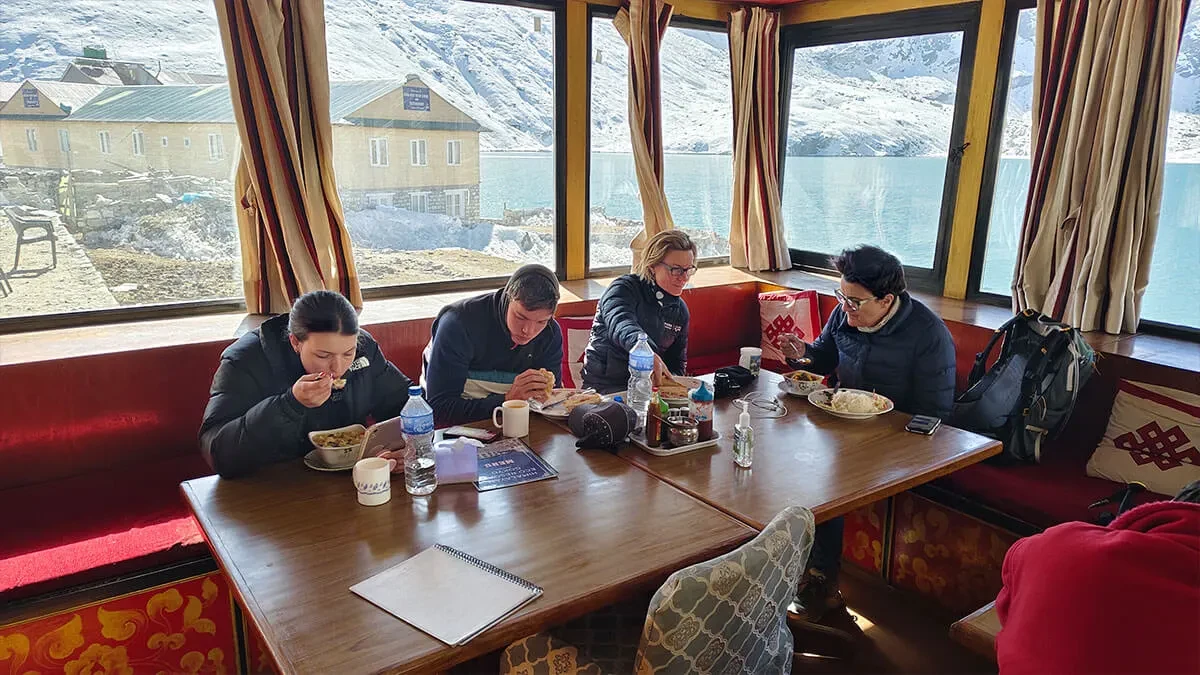
Likewise, the teahouses in the Everest region have a communal dining area, where most trekkers gather for meals, relaxation, and socializing. Most dining rooms have a traditional wood-burning fireplace that keeps the space warm and inviting. Despite the basic nature of these teahouses, they provide a warm, welcoming atmosphere where you can experience authentic Sherpa hospitality, rest comfortably, and enjoy wholesome meals.
Your stay in Kathmandu will be at a well-appointed 3-star hotel close to Thamel. The hotel offers spacious rooms with en-suite bathrooms, high-speed internet, 24-hour hot showers, heating/air conditioning, and wellness facilities.
Meals during the Gokyo Renjo Pass Trekking Route
The package includes breakfast in Kathmandu and all three meals (breakfast, lunch, and dinner) during the trek. Compared to other trekking regions in Nepal, the meals and menu options on this trek are surprisingly diverse, with a combination of Nepali staples, Tibetan delicacies, and Western cuisines.
Breakfast items include chapati roti, Tibetan bread, eggs, toasts, pancakes, porridge, and muesli. The teahouses often serve breakfast with a cup of preferred hot drinks, usually tea or coffee.
For lunch and dinner, Dal Bhat is the most popular choice among locals and foreigners alike. This traditional Nepali meal consists of steamed rice, lentil soup, vegetable curry, and pickle. This hearty meal provides the energy needed for long trekking days and often comes with unlimited refills.
Other typical meals include thukpa, momo, potato dishes, noodles, fried rice, chowmein, pizza, pasta, and Sherpa stew. Most teahouse menus also include hot and cold drinks, including instant coffee, various teas, hot chocolate, soft drinks, and juices. You can also find different types of snacks and chocolate bars in small shops and cafes that appear occasionally along the trail.
Drinking Water
Staying hydrated is crucial during the Gokyo Renjo Pass Trek, with trekkers needing to drink about 4 liters of water each day. Drinking water is readily available throughout the trek, as the teahouses provide tap and boiled water. Although many locals drink untreated tap or stream water, we strongly advise against doing so.
Instead, carry a filtered water bottle and ask teahouse owners to boil water for refills. Boiled water is safer to drink and helps keep you warm in cold conditions. Most teahouses in the Everest region charge a small fee of $1 to $5 per liter. Although boiled water is much safer, we strongly recommend using purification tablets or drops to treat the water before drinking. You can also bring electrolyte powder or flavors to help with both taste and hydration.
Bottled water is available at local teahouses and shops along the trail. However, we do not recommend buying bottled water in the mountains due to environmental concerns.
Hot Shower
Hot showers are available at almost all teahouses along the Gokyo Renjo Pass Trek for a small fee. At lower elevations like Lukla, Phakding, and Namche Bazaar, you can expect electric or gas-powered hot showers at a nominal fee of around $2 to $5. While the teahouses in these regions offer continuous running hot water, the shower time may be limited to a quick wash to reduce energy and water use.
At higher altitudes beyond Namche Bazaar, hot showers often become a luxury. Here, the teahouses offer bucket showers heated by wood-fired stoves. Although cold showers are typically free, they are not advisable given the freezing temperatures at high altitude.
We strongly advise against taking showers above 3,500 meters to avoid blistering cold and the risk of altitude sickness. It is best to skip showers for a few days and freshen up properly once you return to a lower altitude. If you’re uncomfortable skipping showers for a few days, you can use a damp towel or wet wipes as an alternative.
Mobile Network and Internet Connectivity
Mobile network and internet connectivity are available in most parts of the Everest region, though reliability varies significantly depending on altitude and location. Major carriers like Nepal Telecom and Ncell provide reliable network and 4G services in the lower reaches of the trek. The coverage is decent for standard voice calls, text messaging, and using social platforms.
Beyond Namche Bazaar, there is little to no connection to mobile networks, which means no mobile data either. Wi-Fi connectivity is available in most teahouses for a small fee of $4 to $5 per device. While internet speed is decent in larger villages like Lukla, Namche Bazaar, and Gokyo Valley, it is not as consistent in the other remote villages. Likewise, Wi-Fi connectivity can also be affected by bad weather, heavy usage, and technical issues.
For a faster and more reliable experience, we recommend using a volume-based Wi-Fi card from Everest Link. This satellite-based Wi-Fi service is available in most sections of the trek, including Gokyo, Dole, and Macchermo.
Electricity
Electricity is available in all villages and teahouse settlements along the Gokyo Renjo Pass Trek. At lower elevations like Lukla, Phakding, and Namche Bazaar, you’ll find reliable electricity supplied by a small hydroelectric station. At higher altitudes, teahouses still depend on solar power.
You don’t need to worry about charging your mobile phones and electronic devices during the trek. However, electricity availability and charging come with some critical considerations. Usually, the cost to charge your electronic devices ranges from $2 to $5, depending on the altitude. Teahouses typically charge per device or by the hour for battery charging.
Most teahouses do not have charging sockets in rooms, except in high-end hotels or a few teahouses in lower villages. They usually have a communal charging station in the dining hall. During busy seasons, the limited charging sockets can fill up quickly, leading to long waits to power your devices. We strongly recommend carrying a Type-C or Type-D adapter and a 220V–240V charger for convenience.
Since villages at higher altitudes depend on solar power, charging availability depends on weather conditions. On cloudy days, charging facilities may be limited or unavailable. Therefore, it is highly recommended to carry extra batteries and a power bank (20,000 mAh or higher) to charge essential devices like phones, cameras, and headlamps.
ATMs and Money Exchange
Although a few teahouses and local shops in the Everest region accept credit cards and foreign currency, most still prefer Nepalese Rupees (NPR). Therefore, you should carry enough cash for extra expenses, including hot showers, Wi-Fi, battery charging, snacks, and drinks.
Namche Bazaar is the last village on the Gokyo Renjo Pass Trek with ATMs and money exchange facilities. However, you cannot rely on them as they’re often out of cash or broken. It is strongly recommended to exchange your money in Kathmandu for reliability and better exchange rates. You can visit several exchange centers in Thamel to compare rates and choose the best option.
You can also find 24/7 ATM lounges in the commercial neighborhoods of Kathmandu. You should withdraw sufficient Nepalese Rupees (NPR) from these ATMs before the trek. However, ATM withdrawals usually charge a fee of $4 to $5 per transaction. Although most ATMs in Nepal display Visa or Mastercard signs, they often do not accept international cards. For international card transactions, Standard Chartered, Nabil Bank, and Himalayan Bank are considered the most reliable options in Nepal.
Guide and Porter Information
At Nepal Gateway Trekking, we provide an exceptional team of local guides and porters to ensure your Gokyo Renjo Pass Trek is safe, comfortable, and hassle-free. All our guides are WFR-certified with extensive training in first aid, mountain rescue protocols, and altitude sickness management.
With decades of experience in high-altitude trekking and expeditions, our guides share deep insights into Sherpa culture, local tradition, and mountain lifestyle. Beyond trail navigation, they handle all logistics, conduct health screenings, and monitor weather conditions daily to prioritize your safety and the success of the trek.
Our porters are the backbone of all our trips and expeditions. These highly reliable individuals carry your luggage across the challenging terrain of the Everest region to reduce your physical strain and enhance your trekking experience. Unlike other companies, we at Nepal Gateway Trekking implement a strict weight limit policy and appropriate porter-to-trekker ratio to ensure their well-being.
We follow the ethical guidelines of the International Porter Protection Group (IPPG) by providing them with above industry-standard wages, proper equipment, comprehensive insurance coverage, and appropriate accommodation. Moreover, we also conduct annual training and workshops on safety standards, first aid, and responsible practices to maintain consistent service quality.
Gratitude for the Trekking Crew
Showing gratitude to your senior guide and crew members is a special part of trekking in Nepal. Although tipping is not mandatory, it is more like a standard ritual to honor the hard work and expertise of the trekking crew. For many guides, porters, and field staff, tips make up a significant portion of their income and livelihood.
While there is no clear-cut rule for the tipping amount, a general guideline is to tip around 10-15% of their total income. However, this can vary based on their service quality, group size, trek difficulty, and trek duration. In Nepal, it is a common practice to tip the guides and crew members at the end of the trek during the farewell ceremony or a team meeting.
While cash tips are most appreciated, you can also show appreciation to the trekking crew through non-monetary gestures. You can donate or gift your trekking equipment, clothes, accessories, and footwear to the crew members. As long as your pre-owned items are in decent condition, they’ll become valuable for guides and porters for years. Additionally, you can leave positive reviews and share your experience on online platforms and personal blogs to boost their reputation and future opportunities.