TL;DR
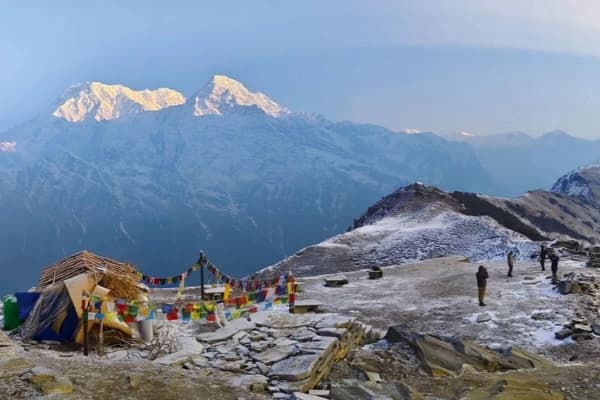
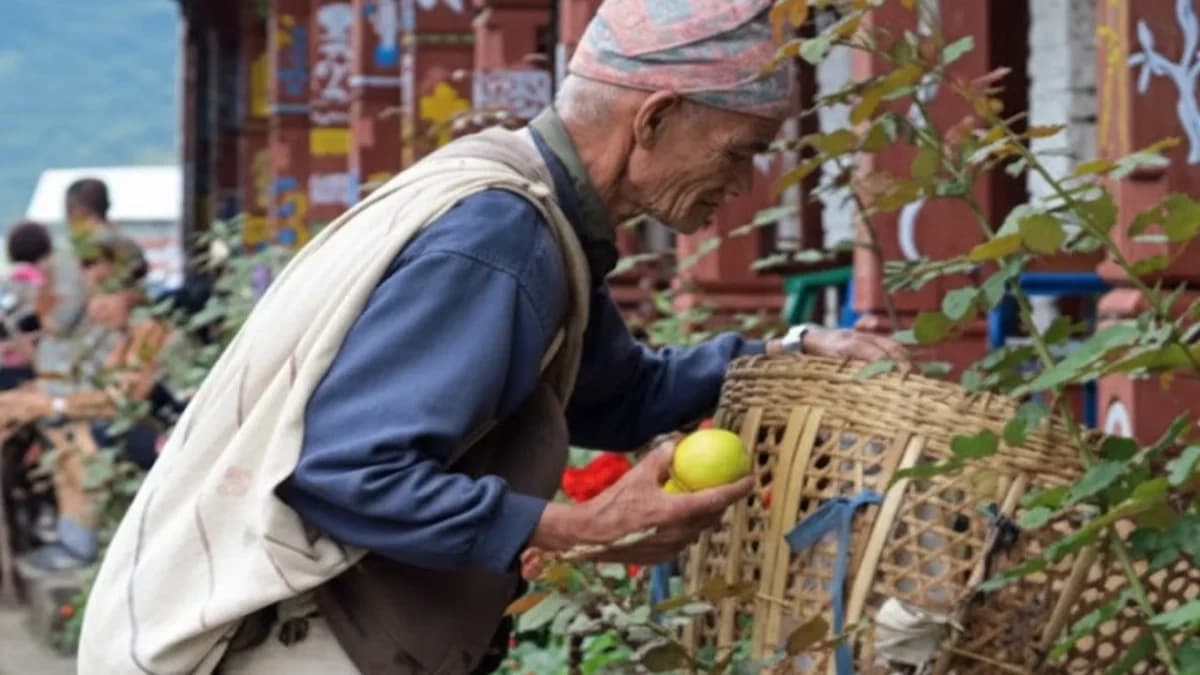
- The Gurung (Tamu) people are closely connected with the hills around Annapurna, where many Gurung villages have existed for generations.
- Their story covers where they came from, how they built their communities, and how Gurkha service, migration and tourism have changed life over time.
- Tamu Kyi is the traditional Gurung language, although Nepali is now much more common in everyday life, especially among younger people.
- Food, clothing, music, Ghatu and Sorathi dances, Tamu Lhosar and other festivals are still important ways Gurung traditions are passed on.
- Gurung beliefs are not limited to one tradition. Buddhism, shamanic practices, ancestor worship and Hindu influences can all be found in Gurung communities.
- If you're trekking through Ghandruk, Sikles, Landruk or Ghale Gaun, the villages themselves offer a chance to see this culture beyond the usual mountain scenery.
Most trekkers walk through the stone-paved alleys of the Annapurna region, admiring the view, yet completely miss the living history surrounding them. Those sturdy stone houses aren't just "rustic architecture"; they are engineered to survive Himalayan winters and seismic shifts. That grandmother offering you a steaming cup of butter tea isn't just being hospitable; she is practicing a sacred code of welcome that has defined these mountains for centuries.
At Nepal Gateway Trekking, after decades of leading trails through the heart of the Annapurna, we’ve realized that the standard guidebooks barely scratch the surface. The Gurung people, who call themselves Tamu, are far more than just "mountain dwellers" or the legendary "Gurkha soldiers" the world knows them as.
They are a people with a complex, vibrant identity that defies simple categorization. They speak Tamu-Kyi, a language that echoes their nomadic roots. They follow a spiritual path that beautifully weaves together three distinct belief systems. And perhaps most interestingly, they operate under a social structure that exists entirely outside of Nepal’s traditional Hindu caste system.
If you want to truly "see" the Annapurna, you have to understand the people who have shaped its ridges and valleys. Here is the cultural soul of the Tamu people that every trekker should know.
Who Are the Gurung People?
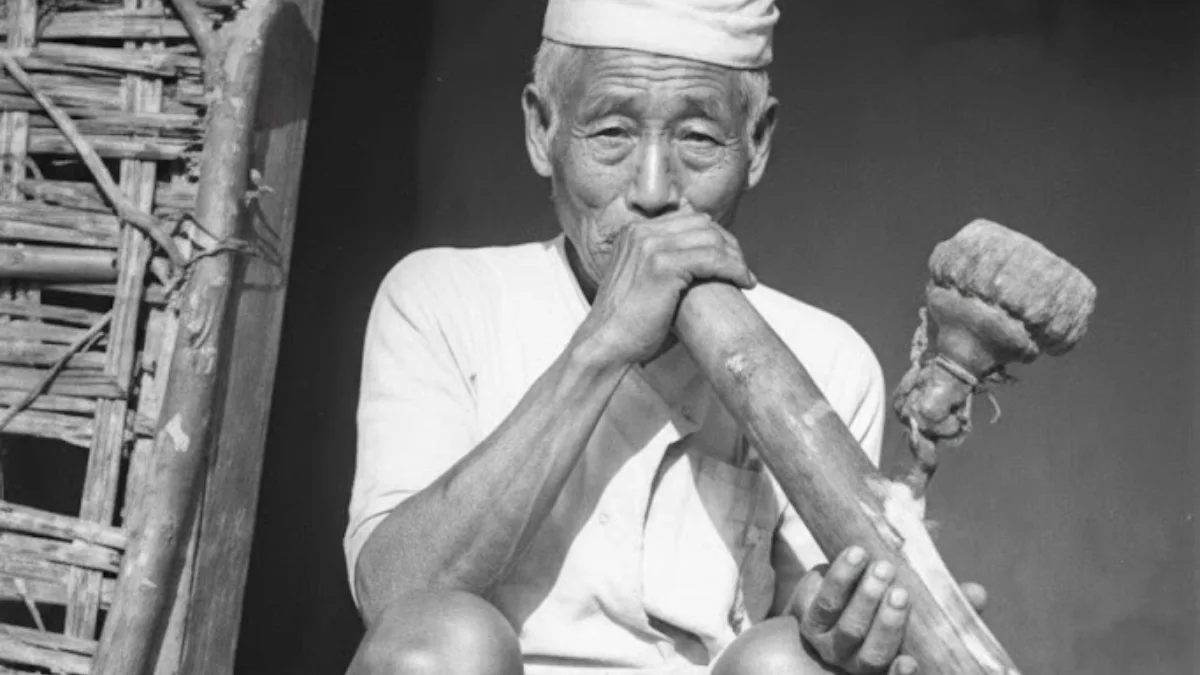
The Gurung, or Tamu, are the primary inhabitants of Nepal’s central mid-hills. If you are trekking to Annapurna Base Camp or the Annapurna Circuit, you are walking through their ancestral lands. Their traditional strongholds are in the Lamjung, Kaski, Syangja, Gorkha, and Manang districts.
Villages like Ghandruk, Sikles, and Bhujung are the heart of this culture. These are active communities where life still revolves around terraced farming and livestock. While many have moved to cities or served in the military abroad, about 543,790 people in Nepal identified as Gurung in the 2021 Census.
The name Tamu has deep roots. In their own language, it translates to "horsemen" or "those from the mountains." This name reflects their history as high-altitude traders and herders before they settled in the mid-hills you see today.
Where Did Gurungs Come From? The Migration Story
This part is pretty interesting. The Gurung people's history traces back to the Qiang people of western China, particularly the Qinghai region, according to some accounts of their early history. Their ancestors were nomadic herders who migrated south from the Tibetan plateau, possibly 1,500 to 2,000 years ago. According to the National Foundation for Development of Indigenous Nationalities (NFDIN), Gurung traditions also describe their ancestors migrating from the northern Himalayan region into Nepal.
They probably came through Mustang and Manang, those high passes near Tibet. Eventually, they settled on the southern slopes of the Annapurna range, where the climate was better for farming and the altitude was manageable. NFDIN also traces Gurung settlement and migration through the Himalayan and Gandaki regions of Nepal.
Originally, they were transhumance pastoralists. That means they moved their sheep and yak herds up to high pastures in summer and down to lower areas in winter. Over time, they transitioned to settled farming, carving those terraced fields into the mountainsides. This combination of pastoralism and agriculture is also reflected in accounts of traditional Gurung livelihoods.
You can still see that pastoral heritage in their festivals, their spiritual practices, and even their social structure. It didn't just disappear.
Traditional Gurung Architecture and Housing
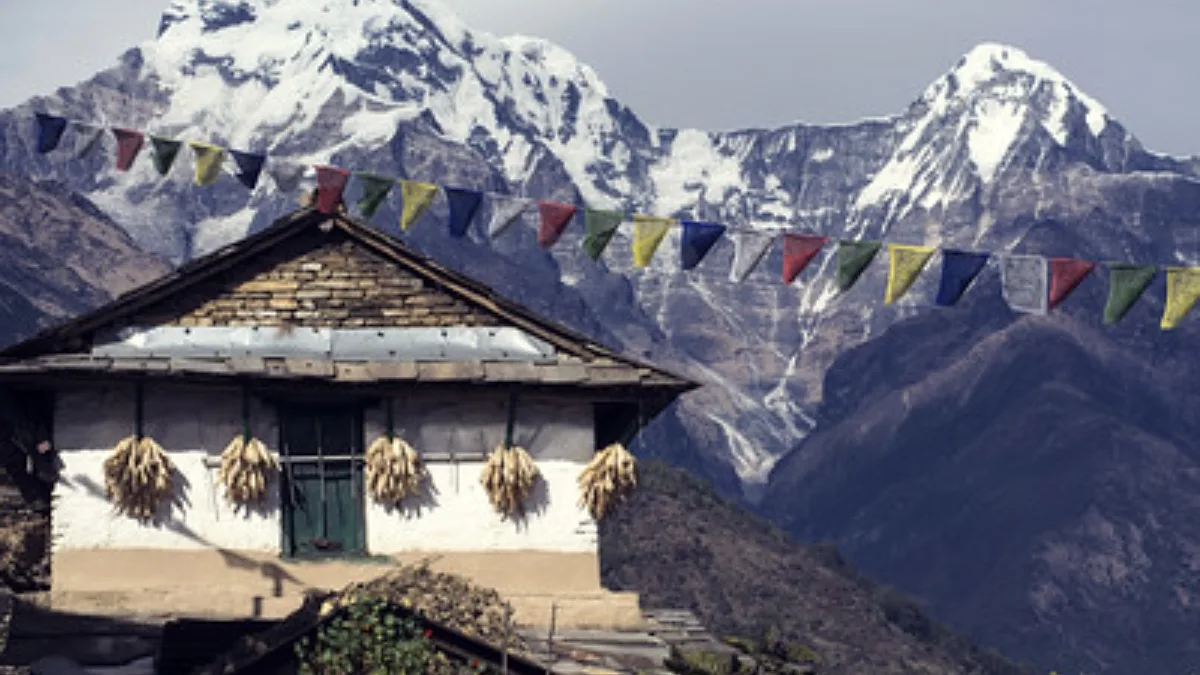
Traditional Gurung houses are built using local stone and slate roofs. This is not just about how they look. Stone helps keep the house warm when it’s cold and cooler when it’s hot. Slate roofs can easily handle heavy monsoon rain. Both stone and slate are also strong during earthquakes, which is very important in Nepal.
The traditional home has several key features:
- Aangan: A stone-paved courtyard where most daily activities happen. People thresh grain, dry crops, kids play around, and neighbors sit together and talk.
- Pidi: A covered porch where people usually gather in the evenings. Elders sit and watch village life, women shell peas while chatting, and men talk about community matters.
- Central hearth: The cooking space where the family spends time together. Traditional homes do not have chimneys. Smoke slowly rises through the roof, which helps dry stored grains and keeps insects away from wooden beams.
Villages like Ghandruk still show this traditional style of housing, but modern materials like metal roofs, concrete, and factory-made bricks are now being used more often.
You might like to know about Sinuwa which is also the gateway to himalayas.
Traditional Gurung Dress & Attire
Gurung clothing was built for mountain life first, though it ended up being striking too. Pieces are woven from sheep wool, cotton, or silk depending on the occasion.
- Women's Attire: Women typically wear a Ghalek, a shawl wrapped diagonally across the body, with a Chaubandi Cholo (a fitted, double-breasted velvet blouse) and a pleated Phariya skirt tied at the waist. Jewelry finishes it off with a Nau Gedi (nine-bead gold necklace), a Kantha Mala (red felt strung with gold beads), and usually large gold earrings.
- Men's Attire: Men's clothing centers on the Bhangra, a woven cotton wrap that also doubles as a way to carry things, paired with a lower wrap called a Kachhad and a sleeveless vest, the Bhoto. A Nepali topi finishes the outfit.
Read: People of the Himalayas
Language and Communication Of Gurung
Gurung language, or Tamu Kyi, is still spoken widely in traditional villages, though it's under pressure from Nepali, which dominates education and government. Older generations speak it fluently, but younger people in urban areas often understand it better than they speak it.
The language has its own script called Tamu Kyir, though not everyone uses it anymore. Most written communication happens in the Devanagari script these days.
What's interesting is how the Gurung people and culture maintain linguistic identity even when switching between languages. In mixed communities, you'll hear people code-switching between Gurung and Nepali mid-conversation, which is pretty common in multilingual Nepal.
The Gurung Language: Tamu Kyi Is Disappearing
The language has built-in respect terms. You call older women "bujae" (grandmother) and older men "bajae" (grandfather) even if they're strangers. This shows how deeply respect for elders is coded into the culture.
When people talk about Gurung culture in nepali language, most Gurungs today are bilingual. Tamu Kyi at home, Nepali for everything else. But the percentages are shifting. More and more young Gurungs speak only Nepali, especially city kids.
The language faces serious threats. No standardized writing system. Nepali-medium schools. Migration to urban areas. Prestige associated with Nepali and English. Some estimates suggest less than half of younger Gurungs can speak Tamu Kyi fluently now.
Community groups are trying to preserve it through classes and documentation, but the trend isn't good.
What are the Traditional Food and Cuisine of The Gurungs?
Gurung cuisine is hearty mountain food, designed to fuel hard physical work in cold climates.
- Dhindo is the staple, a thick porridge made from buckwheat, millet, or cornmeal. It's eaten with vegetable curries, pickles, or meat dishes.
- Gundruk (fermented leafy greens) is essential. Every household makes it, and it's used in soups and curries throughout the year.
- Kodo ko roti (finger millet bread) and fapar ko roti (buckwheat bread) are common, especially during festivals.
- Meat dishes include sukuti (dried meat, usually buffalo or goat), which is smoked and can last for months. During festivals, families prepare blood sausage and various meat curries.
- Tongba and raksi are traditional alcoholic beverages. Tongba is made from fermented millet and drunk hot through a bamboo straw. It's social, warming, and integral to Gurung hospitality.
The Gurung people and culture place strong emphasis on community meals. When there's a celebration, everyone contributes and everyone eats together.
You might like: Famous Nepali Foods and Drinks
Religion and Spiritual Beliefs in Gurung Culture
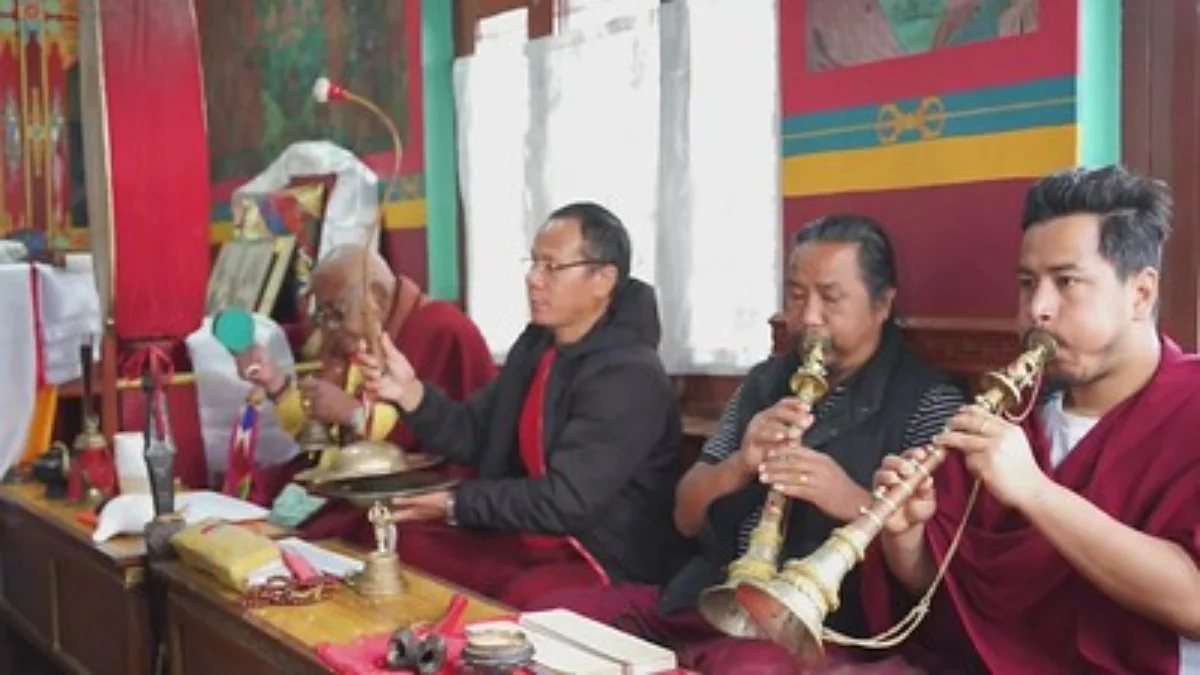
This is where things become more layered. Gurung people and culture mix Buddhism, Shamanism, and Bon traditions in a way that is unique to them.
Most Gurungs see themselves as Buddhist, and in Gurung villages you will often see prayer flags, stupas, and monasteries. But beneath this Buddhist side, there is a strong shamanic tradition. The “poju” and “khlebri” are shamanic priests who carry out healing rituals, communicate with spirits, and act as a bridge between the physical world and the spiritual world.
Bon, the religion that existed in Tibet before Buddhism, also shapes Gurung spiritual practices. Respect for ancestors is very important. Nature spirits are believed in and respected. Mountains, forests, and rivers around the villages all have spiritual meaning in their belief system.
In daily life, most families take part in both Buddhist festivals and shamanic rituals without seeing any conflict. Their religion is lived and practical, changing based on people’s needs instead of strictly following written rules.
Social Structure and Clans of the Gurungs
Gurung society is organized into clans, called "rho." There are four main groups: Char Jaat (four clans) and Sorah Jaat (sixteen clans). The Char Jaat clans traditionally held a higher social status, though this distinction is less rigid now.
Each clan has rules about who can marry whom. Cross-cousin marriage is acceptable in some combinations but forbidden in others. The system is complex, and honestly, urbanization and migration have loosened these rules considerably.
Village leadership traditionally included a "mukhiya" (headman) and a council of elders. These structures still exist in remote areas, though government administration has taken over most official functions.
Gurung Surnames & Clan System (Char Jaat and Sora Jaat)
The Gurung society has traditionally been split into two clan groups, the Char Jaat (Four Clans) and the Sora Jaat (Sixteen Clans). It wasn't just a naming system; it used to shape who held authority in a village and who could marry whom.
If you're wondering about Gurung last names specifically, here are the common ones you'll come across:
- Ghale (historically associated with royalty and leadership)
- Lama
- Ghotane
- Lamichhane
- Pari
- Thapa
- Gurung
City life and migration have loosened a lot of the old rules, but the surnames have stuck around. For most Gurung families in Nepal today, the name is still one of the clearest links back to where they come from.
Gurung People Religion: Three Traditions Blended Together
This is where Gurung culture gets really interesting. When you ask about Gurung people's religion, there's no single answer. Their spiritual life mixes three different systems: Bon shamanism, Tibetan Buddhism, and Hinduism.
Bon: The Ancient Foundation
At the core is Bon, the pre-Buddhist shamanistic tradition from Tibet. In this worldview, spirits live in rocks, trees, rivers, caves, and mountains. These aren't symbols. They're real beings that need respect and offerings.
Disturb the wrong rock without proper ritual? Bad things can happen to you or your village.
The Shamanic Practitioners
Traditional Gurung spiritual life centers on two types of practitioners: Pachyus and Klehbris (sometimes called Ghyabri).
- Pachyus diagnose spiritual causes of illness, perform protection rituals, and ward off evil spirits. When someone gets sick in a traditional village, the family might call a Pachyu to figure out which spirit is causing the problem and what offering or ceremony will fix it.
- Klehbris do similar work but often specialize in healing, divination, or specific spiritual tasks. They enter trance states, communicate with spirits, and perform protective ceremonies.
Comparison of Spiritual Practitioners
|
Practitioner |
Primary Role |
Tradition |
|
Lama |
Blessings, funerals, and scriptural rites |
Tibetan Buddhism |
|
Pachyu |
Diagnosing illness and warding off evil spirits |
Bon (Shamanism) |
|
Klehbri |
Healing, divination, and protective ceremonies |
Bon (Shamanic) |
Both roles are passed down through apprenticeship. The knowledge transfers from master to student over the years, sometimes within families, but not always.
Buddhist and Hindu Layers
In northern Gurung areas closer to Tibet, Buddhist Lamas perform many ceremonies. Birth rituals, funerals, blessing ceremonies, and protective rituals. Lots of villages have Buddhist monasteries, stupas, and prayer wheels.
Meanwhile, Hindu festivals like Dashain and Tihar are celebrated widely. But with Gurung's modifications. During Dashain, Gurungs traditionally use a white tika instead of the red one Hindus wear.
Most Gurungs don't see any contradiction here. They move between spiritual frameworks depending on what's needed. Call a Pachyu for one problem, a Lama for another, celebrate Hindu festivals, all without conflict.
Major Festivals of Gurungs: When the Gurung Villages Truly Come Alive
If you want to see the Gurung community at its most vibrant, you have to see them during a festival. It’s a time when the "living history" we mentioned moves out of the stone houses and into the streets through music, dance, and incredible community feasts.
Tamu Lhosar: The New Year
The most significant cultural celebration for the Gurung community is Tamu Lhosar, which marks the traditional Gurung New Year.
Celebrated annually on the 15th day of the Nepalese month of Poush (mid-December to January), Tamu Lhosar follows a 12-year animal cycle system known as the Lhov, similar to the lunar calendar, where each year is represented by a specific animal such as a deer, sheep, eagle, or snake.
Heritage villages like Ghandruk, Landruk, Sikles, and Ghale Gaun really come alive during this time. Families travel back, generations gather together, and everyone dresses in full traditional attire.
There's Sael Roti frying in kitchens, homemade millet beer (Chhyang) passed around, and folk dances Sorathi, Maruni, and Ghanto that pull the whole village into the street. Elders give blessings, prayers go out to ancestors, and for a few days the place feels like one big household.
Toho Tehn: Keeping the Spirits at Bay
This festival is unique and happens three times a year. Think of it as a spiritual "spring cleaning" for the whole village.
Groups of young boys march through the alleys, beating drums and clashing cymbals. The goal? To scare away any bad spirits or "spiritual dust" that has settled in the community. It’s loud, energetic, and a great example of how the Gurung people take collective responsibility for the peace and protection of their homes.
Dashain and Tihar: A Local Twist
While these are technically Hindu national festivals, they are fully embraced by the Gurung people. However, they do it their own way.
As we mentioned earlier, look for the white Tika during Dashain, it’s a proud marker of their ethnic heritage. These festivals are less about religious dogma and more about family bonding, massive feasts, and the spirit of togetherness that defines life in the mid-hills.
Traditional Dances and Performing Arts of Gurungs
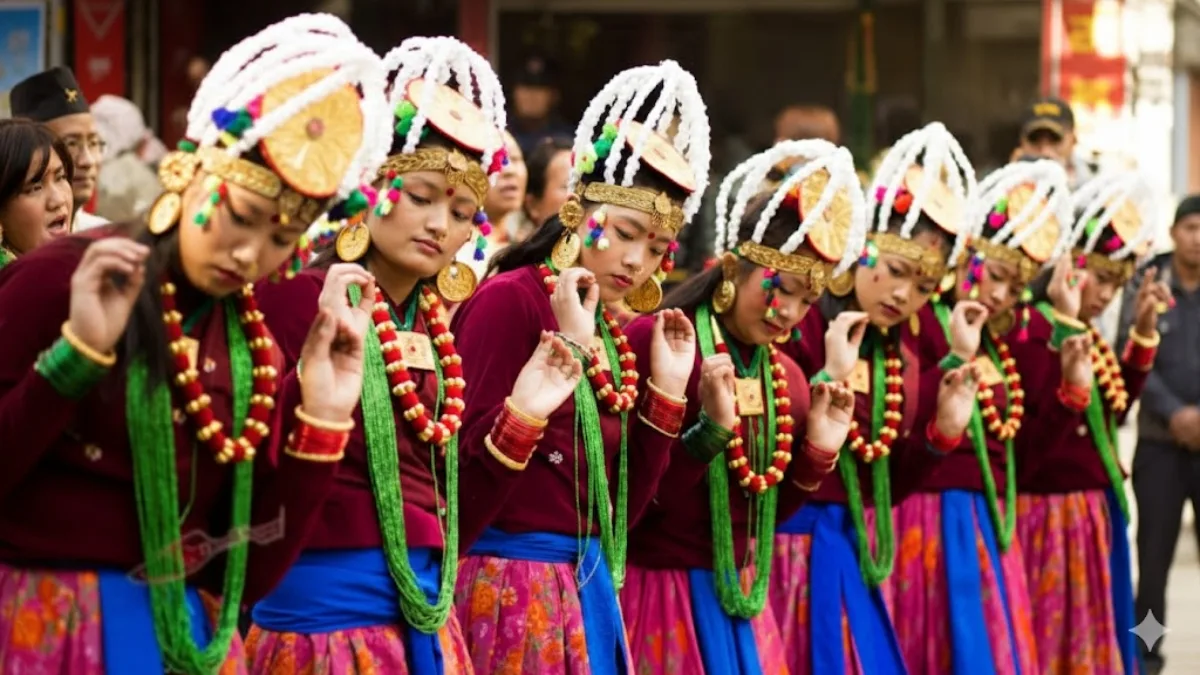
In Gurung culture, music and dance aren't just for entertainment. They act as a living library, passing down history, spiritual values, and social rules from elders to the youth. If you’re lucky enough to witness a performance in a village courtyard, you aren't just watching a show; you’re seeing the community's memory in motion.
- Ghantu Dance: This one is intense. It reenacts a queen who committed sati after her husband died. Young girls perform it, sometimes entering actual trance states. The atmosphere gets emotionally charged and spiritually heavy.
- Sorathi Dance: This is a 16-day dance cycle telling the story of a king with seven wives and a rescued daughter. Different nights cover different parts of the narrative. Traditionally performed during Tamu Lhosar. It requires massive community commitment. The fact that some villages still perform the full 16-day cycle is pretty remarkable.
- Maruni Dance: Performed between July and January, Maruni mixes worship of Hindu deities with comedy and social commentary. Dancers wear elaborate costumes and masks.
- Dohori: The Song Battle: This is a competitive folk song exchange between men and women. Witty, flirtatious, often improvised. You need quick thinking and deep cultural knowledge to do it well. Young people love Dohori because it creates a socially acceptable space for flirting and showing off.
The Rodi: A Vanishing Heartbeat
In the old days, the Rodi was the true pulse of every Gurung village. It wasn't just a place to sleep. It was a shared home where young people learned what it meant to be part of the community. You could almost think of it as a mountain version of a youth club, but with much deeper roots.
When the sun went down, unmarried men and women gathered at the Rodi to sing, dance, and simply be together. While there was plenty of laughter, it was also where the culture survived. This was where elders passed down the tricky steps of the Ghantu dance, the lyrics to ancient folk songs, and the steady rhythm of the weaving loom. It was also where most people found their life partners, all while their neighbors looked on with support.
Today, the real Rodi has mostly faded into memory. As schools opened and young people moved to cities for new opportunities, the need for a central youth house slowly drifted away. You might still see "Rodi" mentioned in cultural shows or for tourists, but the authentic version is rare now. For the older generation, it stays alive as a nostalgic reminder of a time when the whole village felt like one close-knit family.
The Gurkha Legacy of Gurung: How Military Service Changed Everything?
The Gurung connection to Gurkha soldiers is probably what they're most famous for globally.
During the 1814-1816 Anglo-Nepalese War, British forces tried to expand into Nepal. They expected easy victory. Instead, Gurkha fighters (including many Gurungs) fought with such skill and ferocity that British commanders were genuinely shocked.
After the war, the British started recruiting Gurkhas for their army. They specifically preferred Gurungs and Magars, eventually requiring that at least 75% of recruits come from these groups.
The Numbers Tell the Story
Over 120,000 Gurkhas served in World War I. More than 130,000 served in World War II, fighting in North Africa, Italy, Burma, and other theaters.
The most famous Gurung soldier was probably Lachhiman Gurung, who received the Victoria Cross. At Taungdaw, Burma in May 1945, at least 200 Japanese soldiers attacked his position. He threw back two grenades, but the third exploded in his hand, destroying his fingers and severely wounding his arm, face, and body.
Despite these catastrophic injuries, he loaded and fired his rifle with his left hand for four hours, holding off the attack alone. This is why Gurkhas earned their fearsome reputation.
Modern Gurkha Service
Today, Gurkhas serve in the British Army (about 4,000 soldiers), the Indian Army (about 42,000), Singapore Police Force, and Royal Brunei Armed Forces.
The selection process is incredibly competitive. In 2017, 230 trainee riflemen were recruited from about 25,000 applicants. Young men compete through grueling physical tests, including running uphill for 40 minutes carrying 70 pounds of rocks in a wicker basket.
The economic impact on Gurung communities has been enormous. Military remittances account for maybe 25-30% of household income in many Gurung villages. This money funded education, improved infrastructure, and elevated social status.
Economic Transformation Over Generations
The Gurung economy has changed dramatically.
Traditional Economy
- Historically: Transhumance pastoralism (moving livestock seasonally) and subsistence agriculture. Terraced fields for rice at lower elevations, millet and wheat higher up. Animal husbandry integrated with farming.
Military Economy
Gurkha service fundamentally changed everything. Families got regular salaries in foreign currency, pensions, education opportunities, social prestige, and global networks. This created a relatively prosperous class who could invest in businesses, property, and education.
Modern Diversification
Today's Gurung economy includes:
- Tourism: Trekking guides, lodge owners, porters, tourism businesses in the Annapurna region. Ghandruk alone has dozens of teahouses and lodges.
- Business: Shops, transport companies, and hotels in Pokhara and Kathmandu.
- Education: Teachers, professors, administrators.
- Government: Civil service and political positions.
- Agriculture: Still important in rural areas, though often supplemented by remittances.
This diversification is why answering "Is Gurung a high caste?" gets complicated. Many Gurungs have achieved economic and social success that transcends traditional caste frameworks entirely.
What are the Important Life Rituals of the Gurungs?
The important life rituals of the Gurungs include birth rites, marriage ceremonies, and death rituals, all guided by traditional beliefs, clan customs, and ancestral practices. Some of them are
- Putpute: Performed when the eldest male child is about two years old. His maternal uncle conducts the ceremony to honor the clan god and introduce the boy to his spiritual heritage. First major ritual marking his Gurung identity.
- Gunyo-Choli: Marks a girl's transition to womanhood. She's dressed in traditional Gurung-choli and taught about adult women's roles and responsibilities in Gurung society. Both celebration and education.
- Pae Lava: The most elaborate ceremony is performed several years after someone dies (families need time to save money). Its purpose is guiding the deceased's spirit to the afterlife and releasing them from earthly attachments.
The ritual involves creating an effigy of the dead person, animal sacrifices, feasting, and a symbolic dance battle representing the spirit's separation from family ties. Can last several days and costs significant money. But it's considered essential for proper closure and ensuring the ancestor's peaceful afterlife.
Trekking Through Gurung Villages: What to Actually Notice
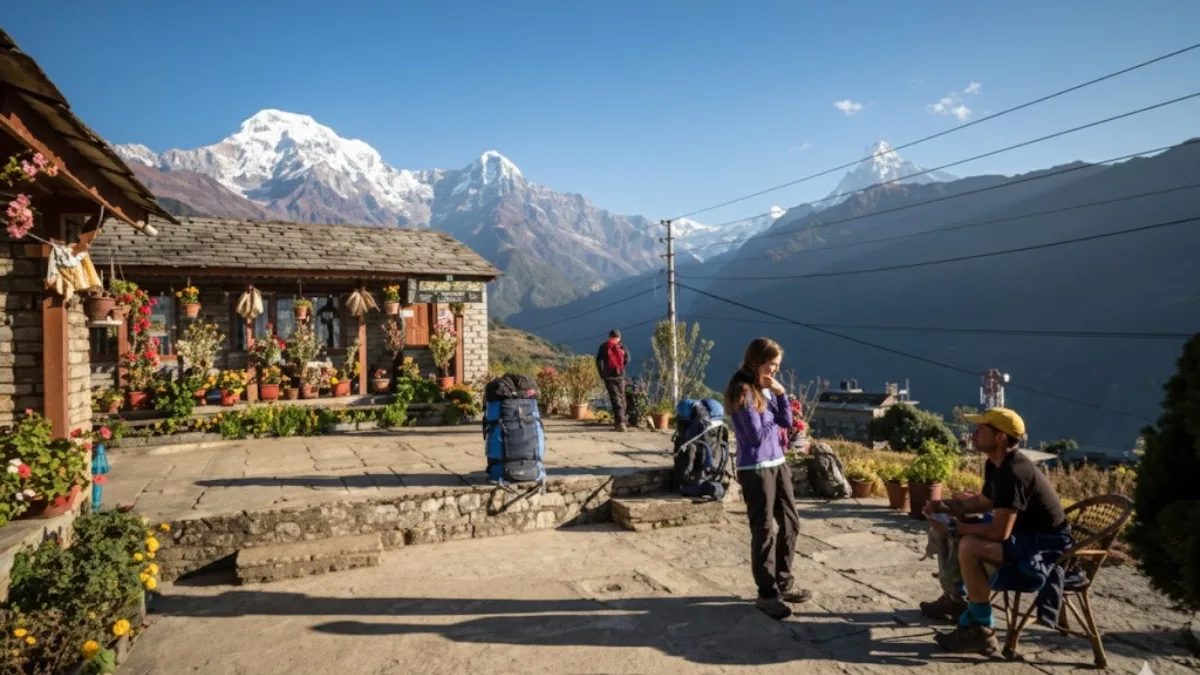
When trekking through the Annapurna region, you're walking through living Gurung culture.
Sikles is one of the largest Gurung settlements. Well-preserved traditions, stone-roofed houses, terraced farmlands. Locals perform cultural dances like Ghatu and Sorathi with traditional instruments.
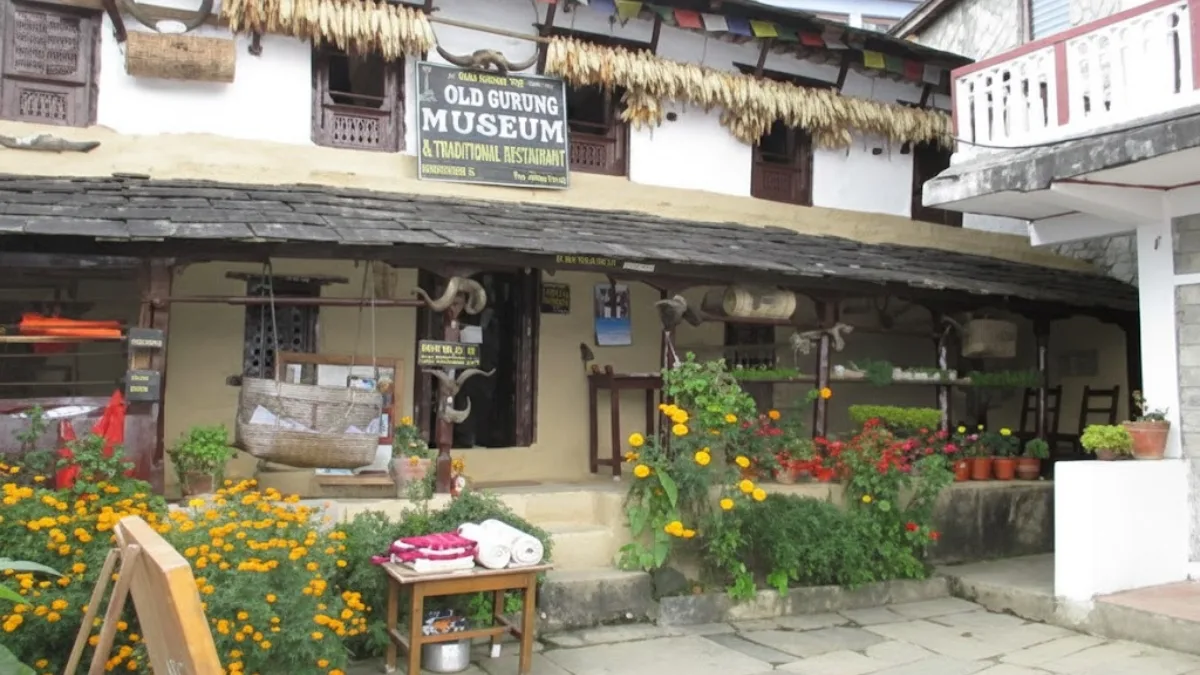
Ghandruk has a Gurung Museum with traditional attire, gear, and handicrafts explaining Gurung history and lifestyle. Worth spending a few hours there instead of just passing through.
Along routes like the Annapurna Base Camp Trek, Annapurna Circuit, and Mardi Himal Trek, you stay in family-run teahouses. The dal bhat you're eating? Prepared by Gurung families. The lodge owner? Probably Gurung. The evening cultural performance? That's real, not staged for tourists (mostly).
This is what makes trekking in Gurung areas different from just mountain scenery. You're engaging with living culture, not visiting a museum.
Read our blog: Best Spring Treks in Nepal
Challenges Facing Gurung Culture Today
Gurung culture and tradition face real threats.
- Language Loss: Tamu Kyi is fading fast. Urban kids speak mainly Nepali or English. When the language goes, the cultural knowledge embedded in it also disappears. Without serious intervention, Tamu Kyi could be functionally extinct in two or three generations.
- Village Depopulation: Young Gurungs leave for cities, education, jobs abroad. This creates labor shortages, aging village populations, difficulty maintaining festivals that need many participants, and loss of traditional knowledge when elders die without teaching the next generation. Some villages are semi-abandoned with only elderly residents.
- Modernization Tensions: Young Gurungs feel caught between tradition and modernity. Arranged versus love marriages. Traditional dress versus Western clothing. Village life versus urban opportunities. Gurung identity versus national Nepali identity.
- Cultural Homogenization: Integration with mainstream Nepali Hindu culture means some distinctly Gurung practices get modified or abandoned. Hindu festivals are great, but when they become more important than Tamu Lhosar, something shifts. Television, internet, social media, mainstream education all promote dominant culture while marginalizing minority traditions.
What's Being Done to Preserve Gurung Culture?
Not everything is loss and decline.
- Government Recognition: Tamu Lhosar is now an official public holiday, giving visibility and legitimacy.
- Cultural Tourism: Villages like Ghandruk developed tourism that creates economic incentives for preservation. When traditional practices generate income, they're more likely to continue.
- Language Programs: Community organizations run Tamu Kyi classes, develop educational materials, advocate for mother-tongue education.
- Digital Documentation: Recording oral histories, songs, and rituals before elderly knowledge-keepers pass away.
- Diaspora Organizations: Gurung communities in London, Hong Kong, and New York maintain cultural associations and celebrate festivals abroad.
- Museums: The Gurung Museum in Ghandruk preserves and explains the culture to outsiders and younger Gurungs who didn't learn from their families.
The key is making culture living and relevant, not just preserved in museums. Cultures that people actually use and find meaning in will survive.
Trek with Nepal Gateway Trekking: Your Gateway to Gurung Culture
At Nepal Gateway Trekking, we don't just guide you through the mountains. We bridge the gap between cultures, helping you understand and appreciate the communities you'll meet along the way.
Why Choose Us for Cultural Trekking?
- Local Knowledge: Our teams and guides come from trekking regions, including Gurung communities, so they provide authentic cultural insights
- Community Connections: We work directly with local homestays and teahouses, making sure your tourism benefits communities directly
- Cultural Sensitivity: We train our team in respectful cultural engagement and educate our clients about local customs
- Flexible Itineraries: We can customize treks to include cultural experiences like festival participation, museum visits, and extended village stays
- Responsible Tourism: We're committed to sustainable practices that support cultural preservation and environmental conservation
Recommended Cultural Treks
- Ghorepani Poon Hill Trek with Ghandruk (4-6 days) Perfect for experiencing Gurung culture in nepali language with manageable trekking. Includes overnight stays in Ghandruk with cultural museum visits.
- Long and Short Annapurna Base Camp Trek (7-12 days) passes through multiple Gurung villages including Ghandruk and Chhomrong. Offers deep cultural immersion alongside spectacular mountain scenery.
- Gurung Heritage Trail is a specialized cultural trek designed specifically to explore Gurung villages, traditions, and lifestyle with minimal altitude gain.
- Mardi Himal Trek is a quieter alternative route through authentic Gurung communities with stunning Annapurna views.
Final Thoughts
The Gurung people have gone through many changes but have stayed true to themselves. From migrating from Tibet, to serving as brave soldiers, to now working as guides and business owners, they have adapted while keeping their roots alive.
What makes them special isn’t just their festivals or dances. It’s how they blend Bon shamanism, Tibetan Buddhism, and Hinduism into daily life, keep family traditions strong, and make military service part of both their work and identity.
If you trek in the Annapurna region, take time to really connect with the villages. Sit on a pidi, drink butter tea, chat with locals, visit the museum, and join Tamu Lhosar if your timing matches.
Want to experience Gurung culture up close? Contact Nepal Gateway Trekking today and plan a cultural trek in the Annapurna region. Let us help you discover Gurung hospitality, traditions, and breathtaking landscapes.
Frequently Asked Questions About Gurung People and Culture
What is the culture of the Gurung?
Gurung culture is a mix of Tibetan Buddhism and ancient Bon shamanic traditions. It includes a clan-based social system, rich performing arts like the Ghatu dance, a strong military history as Gurkha soldiers, and unique architecture and language tied to their Tibeto-Burman roots.
Who can Gurung marry?
Gurung people marry outside their own clan (gotra). Marriage within the same clan is not allowed. A unique tradition is cross-cousin marriage, where boys can marry their maternal uncle’s daughter, and girls can marry their paternal aunt’s son.
Who is the god of Gurung?
Gurungs don’t focus on a single god. They worship many spirits, including nature spirits in rocks, trees, and mountains, ancestral spirits, and protective clan deities. Their religion mixes Tibetan Buddhism, Bon shamanism, and animistic beliefs.
What is Gurungs’ main religion?
Most Gurung follow a combination of Tibetan Buddhism and Bon (pre-Buddhist shamanism). Buddhist Lamas and shamanic Pachyu and Klebre priests both perform ceremonies. Hindu influences are also present in some practices.
Why doesn’t Gurung eat pork?
Many Gurung do eat pork. Some avoid it because of Buddhist dietary rules or clan-specific taboos. Food practices vary by region, clan, and personal choice, so it’s not the same for everyone.
What is the main festival of the Gurung?
Tamu Lhosar, the Gurung New Year, is the main festival. It falls around December 30th and marks the start of spring, following a twelve-year animal cycle. Celebrations include traditional dances, feasts, wearing traditional clothes, and community gatherings.
What are the 16 types of Gurung?
The “16 types of Gurung” refers to the Sorha Jat—sixteen sub-clans grouped under four main clans (Char Jat): Lama, Lamichhane, Ghale, and Ghotane. These clans guide social rules, including marriage.
How can I experience authentic Gurung culture?
The best way is by trekking in the Annapurna region. Stay in Gurung villages like Ghandruk, choose homestays instead of hotels, visit local museums, try to time your visit for Tamu Lhosar, and interact respectfully with the community.
What language do Gurung people speak?
Gurungs speak Tamu Kyi (the Gurung language), which belongs to the Sino-Tibetan language family.
What are common Gurung last names?
Common Gurung family surnames include Ghale, Ghotane, Lamichhane, Pari, Thapa, Lama, and Gurung.
Which famous trekking villages in Nepal are inhabited by Gurungs?
Major Gurung heritage villages in the Annapurna and Gandaki regions include Ghandruk, Landruk, Chhomrong, Sikles, and Ghale Gaun.