Landing in Nepal without local cash can soon turn into a hassle. Some hotels, restaurants, and larger stores in Kathmandu and Pokhara accept cards, but most of Nepal relies on cash only. Taxis, local buses, tea houses, trekking lodges, and small shops only take the Nepalese Rupee (NPR), and ATMs or exchange facilities are rare once you leave the major cities.
Many travelers make the mistake of exchanging money at the airport or waiting until they get to a trekking area to be met with poor exchange rates or difficulty finding a trustworthy exchange service. A few minutes of planning before you set out can help you avoid unnecessary fees and ensure you always have enough cash where electronic payments are not an option.
Thinking of where to exchange money in Nepal? This guide explains where to change money in Nepal, compares licensed exchange counters, banks, ATMs, and airport services, and gives practical tips on getting the best exchange rate in 2026. You will also learn where to change money before entering remote trekking areas and how to check the latest money exchange rate in Nepal so you can exchange with confidence.
Quick Answer: Where Is the Best Place to Exchange Money in Nepal?
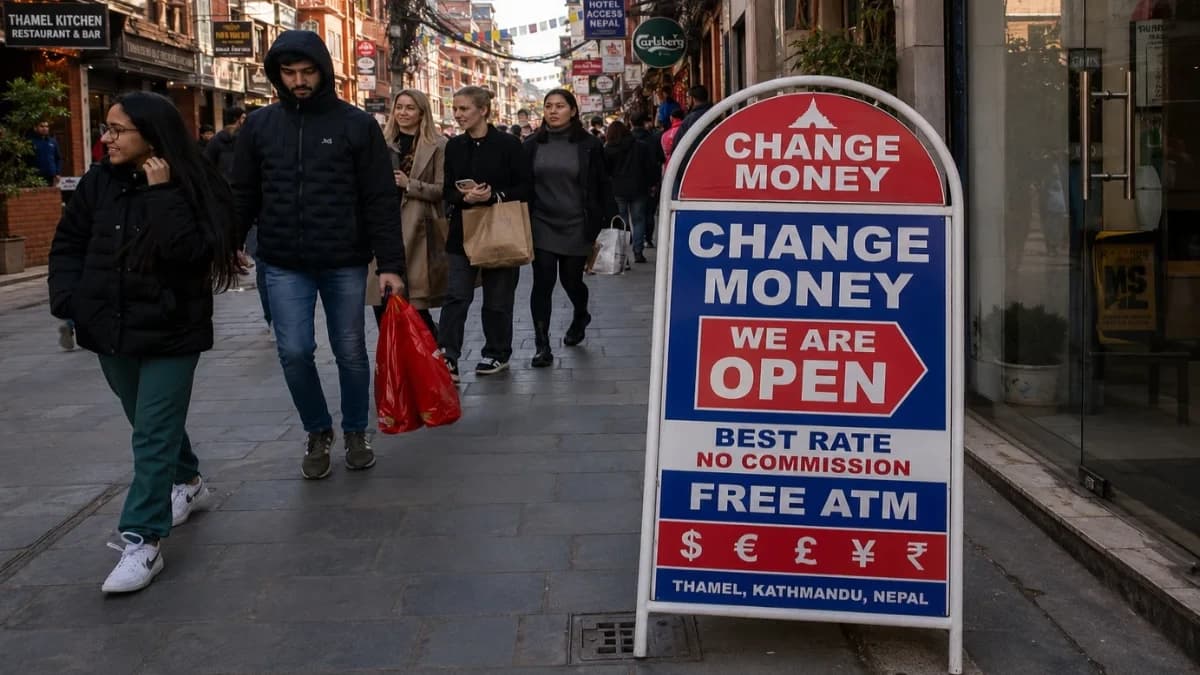
For most travelers, licensed money changers in Thamel Kathmandu or Lakeside Pokhara beat every other option on rate and speed, and together they represent the best currency exchange Nepal has to offer. Exchange only a small amount at the money exchange in Nepal airport counter enough to cover a taxi, a local SIM card, and your first meal, then do the bulk of your currency exchange in the city once you've settled in.
If you're specifically deciding where to exchange money in Kathmandu, Thamel is the obvious starting point.
|
Exchange Option |
Best For | Exchange Rate | Convenience |
|
Licensed Money Changers |
Best overall rates | Excellent | High |
|
Commercial Banks |
Large, secure transactions | Good | Moderate |
|
ATMs |
Convenient withdrawals | Standard | High (Cities) |
|
Airport Counters |
Immediate arrival expenses | Lower | Excellent |
|
Hotels |
Emergency exchanges | Poor | High |
Get the Free Nepal Trekking Budget Checklist to estimate your daily cash needs for food, permits, transport, tips, and accommodation before your trip. Contact Nepal Gateway Trekking now.
Money Exchange Options in Nepal
Each option below suits a different kind of traveler and a different stage of the trip. Here's how to pick the right one depending on your itinerary and how much cash you're carrying.
Licensed Money Exchange Counters
Licensed money changers are the go-to option for most tourists visiting Nepal. Every one of them is registered with Nepal Rastra Bank, the country's central bank, which means the rates on display are regulated and transparent rather than negotiated on the spot.
They also work fast. A straightforward exchange rarely takes more than five minutes, and rates are typically the most competitive of any option covered in this guide. You'll find the highest concentration of these counters in the following:
- Thamel
- Durbar Marg
- Lazimpat
- Lakeside (Pokhara)
Commercial Banks
Banks are the safer, more formal route, especially if you're exchanging a large sum. Nabil Bank, Himalayan Bank, Standard Chartered, and Nepal Investment Mega Bank all offer foreign currency exchange at their branches.
Expect slightly longer processing times than a money changer, usually 15 to 30 minutes once you include paperwork. Bank hours in Nepal generally run from Monday to Friday, and you'll need your original passport plus a filled-out exchange form for every transaction.
Tribhuvan International Airport Exchange Counters
Money exchange at Nepal airport counters is the first thing most visitors see after immigration, and they're genuinely convenient for that reason alone. The catch is that the money exchange rate at Nepal airport desks is consistently lower than at city options because they serve a captive audience.
Use the money exchange at the Nepal airport desk for immediate needs only:
- Taxi fare into the city
- A local SIM card
- Your first meal
Anything beyond that should wait until you reach a licensed counter in town.
ATMs in Nepal
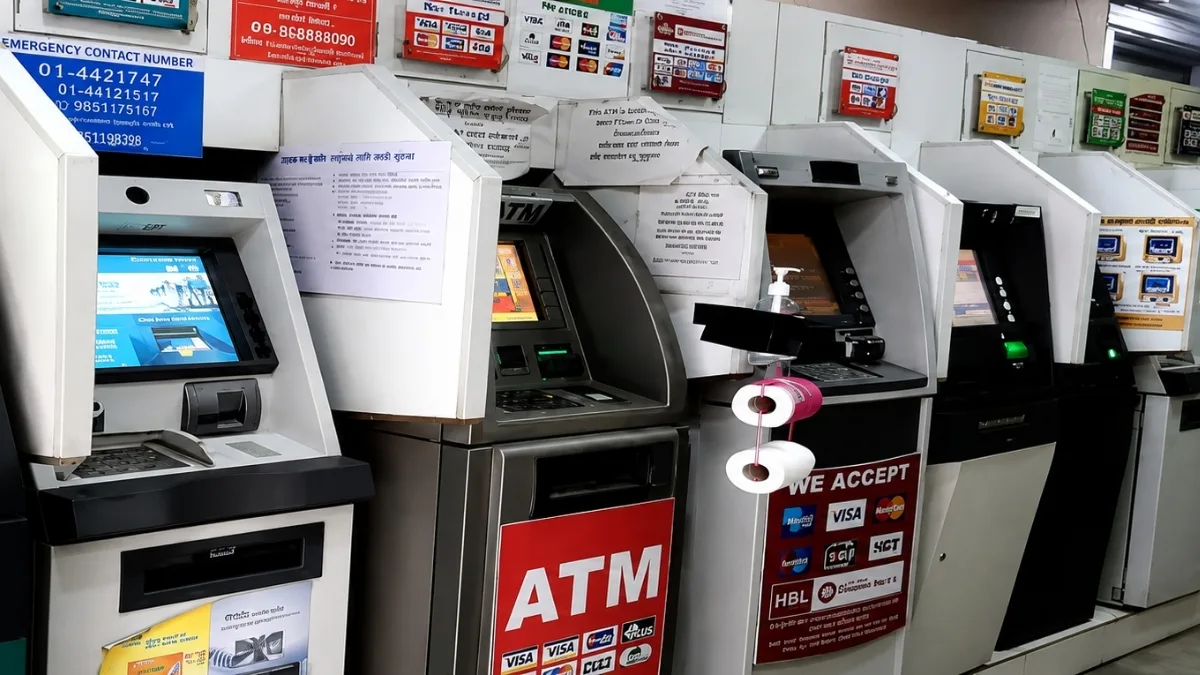
ATMs across Kathmandu and Pokhara accept Visa and Mastercard, and most withdrawals come with a flat service fee plus whatever your home bank charges on top. Daily withdrawal limits typically sit around NPR 35,000, though the amount varies by bank. Urban ATMs are reliable. Once you're outside the main cities, machines become sparse and increasingly unreliable, which is precisely why cash planning matters so much for trekkers.
Hotels
Hotel front desks will exchange currency for you, but the rate is almost always the weakest of any option on this list. Treat it strictly as a backup for after-hours emergencies, not a primary strategy.
Best Places to Exchange Money in Kathmandu & Pokhara
If you're wondering where to exchange money in Kathmandu, the answer is Thamel; it has more licensed counters per block than anywhere else in the country, and the competition keeps rates competitive. Wherever you land in the valley, money exchange in Kathmandu, Nepal, follows the same basic rule: more competition means a better rate for you.
Kathmandu's Best Exchange Locations
- Thamel has the highest concentration of licensed money changers in Nepal, and the rates reflect that competition. Counters like Tridev Money Exchange and North Face Money Exchange are commonly used by travelers as examples of the kind of outlet you'll find on nearly every street here. This list isn't an endorsement, just a sense of what's available. It's consistently the top answer to where to exchange money in Kathmandu, especially if you're already staying in the neighborhood.
- Durbar Marg, Kathmandu's business district, has reliable exchange counters that work well if you're staying at one of the hotels nearby, and it's a fair second option for money exchange in Kathmandu, Nepal, if Thamel is out of your way.
- Lazimpat, home to several embassies and upscale hotels, also offers dependable money exchange in Kathmandu, Nepal, through its hotel-adjacent counters.
- Patan (Lalitpur) has its own smaller cluster of exchange points, including Patan Money Exchange and K.B. Unique Money Changer, useful for money exchange in Kathmandu, Nepal, if you're based on that side of the valley and don't want to cross the river into Thamel.
Pokhara's Best Exchange Locations
Lakeside is Pokhara's equivalent of Thamel, a dense strip of commercial banks and licensed exchange counters that's especially convenient if you're heading toward the Annapurna region straight after. Most exchange services in Lakeside accept major currencies such as US dollars, euros, British pounds, Australian dollars, and Japanese yen. Since rates and service fees can vary from one counter to another, it's worth comparing a few options before exchanging a large amount.
If you need cash for your trek, Pokhara is one of the last places with reliable banking services before you enter many trekking routes. Exchanging or withdrawing enough Nepalese rupees here can save you time and inconvenience, as exchange facilities become limited or unavailable in mountain villages. While ATMs are widely available around Lakeside and central Pokhara, they may charge withdrawal fees and have daily transaction limits.
Kathmandu vs. Pokhara: Which Offers Better Exchange Rates?
|
Feature |
Kathmandu | Pokhara |
| Number of Exchange Counters | High | Moderate |
|
Competition |
Very High | High |
| Typical Rates | Slightly Better | Competitive |
|
Convenience |
Excellent | Excellent |
Kathmandu generally edges ahead on rates because there are simply more counters competing for your business. That said, Pokhara's rates stay close enough that the difference rarely is relevant for anything short of a large exchange. If your itinerary starts in the capital, settle on where to exchange money in Kathmandu first, then treat Pokhara as a top-up stop later in your trip.
Not sure how much cash you'll actually need? Read our complete trek packages to find out how much money to carry for a Nepal trek before finalizing your travel budget.
Nepal's Currency (NPR): Every Traveler Should Know
The Nepalese Rupee (NPR), symbol Rs., is the country's sole legal tender for local transactions. Common banknotes come in Rs.20, Rs.50, Rs.100, Rs.500, and Rs.1000 denominations, and you'll want a mix of small and large notes on hand at all times.
When you check any money exchange rate in Nepal, you'll see two figures side by side: the buying rate and the selling rate. The buying rate is what a counter pays you for your foreign currency, while the selling rate is what they charge you to buy it back. The gap between the two is the exchange spread, and it's how money changers make their margin.
The international money exchange rate in Nepal is published daily by Nepal Rastra Bank and used as the reference point for every licensed counter and bank in the country. Rates do shift day to day, so it's worth checking the current international money exchange rate in Nepal the morning you plan to exchange rather than relying on a figure from a few days earlier.
Most counters post the day's money-exchange rate in Nepal on a board near the entrance, so you can compare it against the official figure before you commit to a transaction. Tracking the international money exchange rate in Nepal for a few days before your trip also gives you a sense of whether rates are trending in your favor.
Foreign currency isn't accepted for most day-to-day purchases. Restaurants, taxis, and trekking services all expect rupees. Carry your passport whenever you exchange money, since it's required by law for every legal transaction.
Which Foreign Currencies Can You Exchange in Nepal?
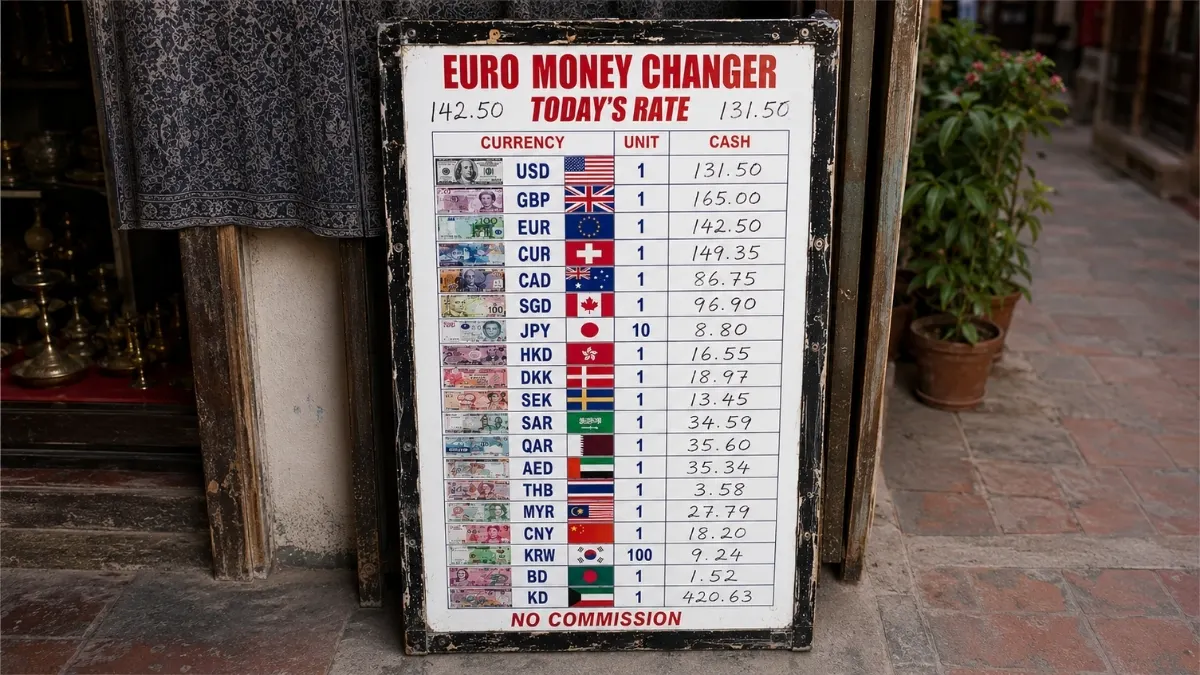
IMAGE NOTE: Image for reference only. The exchange rates shown are illustrative and do not reflect live market rates. Actual rates vary by date, exchange provider, and market conditions.
Nepal accepts a wide range of foreign currencies through licensed money changers and commercial banks. However, not every currency is exchanged everywhere. Major international currencies are widely available, while less common currencies may only be accepted at larger banks or exchange counters in Kathmandu and Pokhara.
The following currencies are commonly accepted for exchange in Nepal:
|
Currency |
Availability in Nepal |
| US Dollar (USD) | Widely accepted; offers some of the best exchange rates |
| Euro (EUR) | Accepted at most licensed exchange counters and banks |
|
British Pound Sterling (GBP) |
Commonly exchanged throughout Nepal |
| Australian Dollar (AUD) | Available at major exchange counters |
| Canadian Dollar (CAD) | Accepted by most banks and larger money changers |
|
Japanese Yen (JPY) |
Commonly exchanged, especially in tourist areas |
| Swiss Franc (CHF) | Available at larger commercial banks and licensed counters |
| Singapore Dollar (SGD) | Accepted by many exchange services |
|
Chinese Yuan (CNY) |
Available at selected banks and exchange counters |
| Indian Rupee (INR) | Accepted under Nepal Rastra Bank regulations, subject to denomination and exchange rules |
Banks vs. Licensed Money Changers: Which Offers Better Exchange Rates?
In Nepal, the bank exchange rates are lower than those of money changers. Banks offer official, well-regulated service, but licensed money changers tend to post slightly better retail rates because they're competing directly with each other on busy tourist streets.
|
Feature |
Commercial Banks | Licensed Money Changers |
| Exchange Rate | Good | Often Better |
|
Processing Time |
15–30 minutes | 2–5 minutes |
| Documentation | Passport + Forms | Passport |
|
Fees |
Possible | Usually Minimal |
| Flexibility | Limited | More Competitive |
If you're moving a large sum and want the paper trail of a bank, that's a reasonable trade-off. For everyday travel amounts, the licensed counter down the street usually offers better exchange rates than banks in Nepal.
It's worth checking the posted money exchange rate in Nepal at both a bank and a nearby money changer before you decide, since the gap can occasionally be small enough that the bank's extra security is worth it.
How to Exchange Money in Nepal (Step-by-Step)
Here's exactly how to exchange money in Nepal without losing value to a bad rate or getting caught out by hidden fees:
- Before you head out, check the daily exchange rate from Nepal Rastra Bank.
- Carry your original passport; copies aren't accepted.
- Visit a licensed exchange counter or commercial bank.
- Compare rates at two or three nearby counters if you're exchanging a large amount.
- Ask directly whether any commission or service fee applies.
- Complete the exchange and get your receipt.
- Count your cash right there before you leave the counter.
- Keep the receipt in case you need to convert leftover rupees back before you leave.
Following these steps is really all you need to know to exchange money in Nepal safely and at a fair rate.
Airport vs. City Exchange Counters: Which Saves You More?
Say you're exchanging USD 500. At the airport, you might absorb a rate roughly 2–3% weaker than what's on offer in Thamel, a difference of somewhere between USD 10 and 15 lost purely to convenience.
Change that same USD 500 at a licensed Thamel counter instead, and you'll typically walk away with noticeably more rupees in hand for the identical amount of foreign currency. The smartest approach: exchange a small amount, say USD 40–50, at the airport for your immediate needs, then handle the rest once you're settled into your hotel in the city.
Money Exchange Tips for Trekkers
If your trip includes Everest Base Camp, Annapurna Base Camp, the Annapurna Circuit, Langtang, Manaslu, or Upper Mustang, your cash planning needs to happen entirely before you leave Kathmandu or Pokhara.
ATMs simply don't exist along most of these trails, and even where teahouses accept card payments, the surcharge and unreliable connectivity make cash the only practical option. You'll need rupees for:
- Teahouse rooms and meals
- Hot showers
- Charging your phone or camera battery
- Wi-Fi access
- Local transport to the trailhead
Expert Tip: Exchange your larger denominations (USD 50 or 100 notes) in Kathmandu for the best rate, then ask the counter to break some of it into smaller NPR notes (Rs. 100 and Rs. 500) before you head out. Teahouse owners rarely change a Rs.1000 note on a quiet trekking day.
Getting how to exchange money in Nepal right mostly comes down to avoiding a handful of predictable mistakes and remembering that bank exchange rates are usually lower than money changers' in Nepal, which typically tips the decision toward a licensed street counter.
Common Money Exchange Mistakes to Avoid
- Exchanging your entire trip budget at the airport
- Relying on hotel exchange desks when a licensed counter is nearby
- Heading into a trekking region without enough cash on hand
- Handing over damaged or heavily worn Nepalese banknotes
- Using unlicensed street money changers
- Not asking about commission before the transaction
- Losing or discarding your exchange receipt
Security, Safety & Managing Exchange Rate Changes
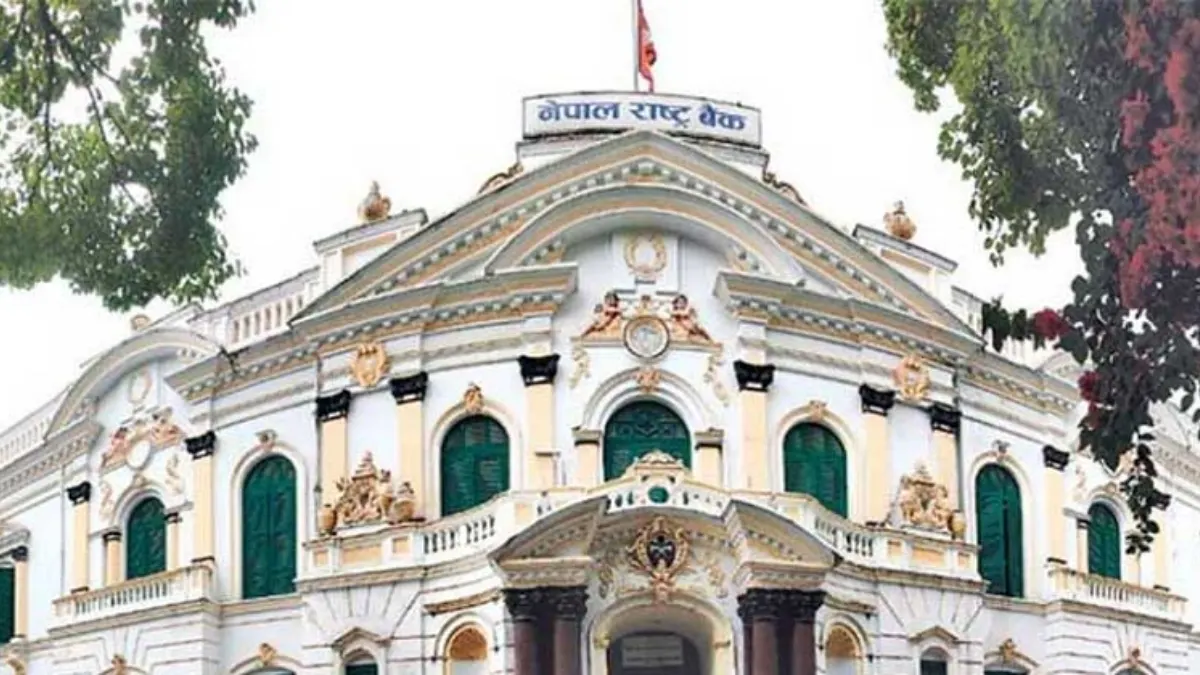
Look for Nepal Rastra Bank's authorization certificate displayed at the counter; every legitimate money changer has one on the wall. Check the day's live rate before you exchange, since it can move slightly from one morning to the next.
Split your cash across two bags rather than carrying it all in one place, and keep a small emergency fund separate from your main stash. Inspect notes for tears or excessive wear before accepting them, since damaged rupees can be difficult to spend later, and stick to authorized counters to avoid counterfeit currency altogether.
It's also worth asking yourself, are bank exchange rates lower than money changers' in Nepal each time you travel, since competition among counters can shift from one trip to the next.
You've sorted your currency. What's next? Continue planning your adventure with our guides on trekking permits, packing lists, travel insurance, transportation, and the best trekking seasons in Nepal.
Final Thoughts
Exchange the bulk of your money at a licensed counter in Kathmandu or Pokhara; that's where you'll consistently find the best currency exchange in Nepal. Use the money exchange in the Nepal airport desk only for your first few hours in the country, compare rates before committing to any single counter, and make sure you're carrying enough cash before heading into a trekking region with no banking access.
Remember that bank exchange rates are often lower than money changers in Nepal, so a licensed street counter is usually your fastest path to a fair deal. Stick to authorized providers throughout, and you'll get the best currency exchange rates in Nepal without any surprises.
Preparing for a trek in Nepal? Nepal Gateway Trekking helps you plan every detail from choosing the right trekking route and obtaining permits to budgeting, currency exchange, and on-the-ground support.
Frequently Asked Questions
Where is the best place to exchange money in Nepal?
Licensed money changers in Thamel (Kathmandu) or Lakeside (Pokhara) consistently offer the best rates. For larger amounts, consider using commercial banks as a solid alternative, while for small, immediate expenses, use airport counters and hotels.
How do I exchange money in Nepal legally?
Visit a licensed money changer or commercial bank registered with Nepal Rastra Bank, and bring your original passport. Avoid unauthorized street changers; even if they offer a slightly better-sounding rate, the risk isn't worth it.
Can I exchange US dollars across Nepal?
Yes, US dollars are the most widely accepted foreign currency at money changers and banks throughout Nepal. Most licensed counters also accept euros, British pounds, and a handful of other major currencies.
Should I exchange money before arriving in Nepal?
It's not necessary and rarely offers a better rate than exchanging in Kathmandu or Pokhara. Bring a small amount of cash for your first day, then exchange the rest once you've landed.
Can I rely on credit cards while trekking in Nepal?
No. Card acceptance disappears almost entirely once you leave Kathmandu or Pokhara, and even where it exists, surcharges and unreliable power make it unreliable. Carry enough cash for your entire trek.
Do I need my physical passport to exchange currency?
Yes, every licensed money changer and bank in Nepal requires your original passport for currency exchange. Photocopies or photos of your passport won't be accepted.
Can I exchange leftover Nepalese rupees before leaving Nepal?
Yes, licensed money changers and the airport exchange counter will convert unused rupees back to foreign currency, provided you have your original exchange receipts. Keep those receipts throughout your trip for this reason.
Where can I check today's official money exchange rate in Nepal?
Nepal Rastra Bank publishes the daily international money exchange rate in Nepal on its website each morning, and most licensed counters display the same figure at their desks. Checking it before you exchange helps you spot a counter-quoting below the standard rate, ensuring you always get the best currency exchange Nepal has to offer that day.