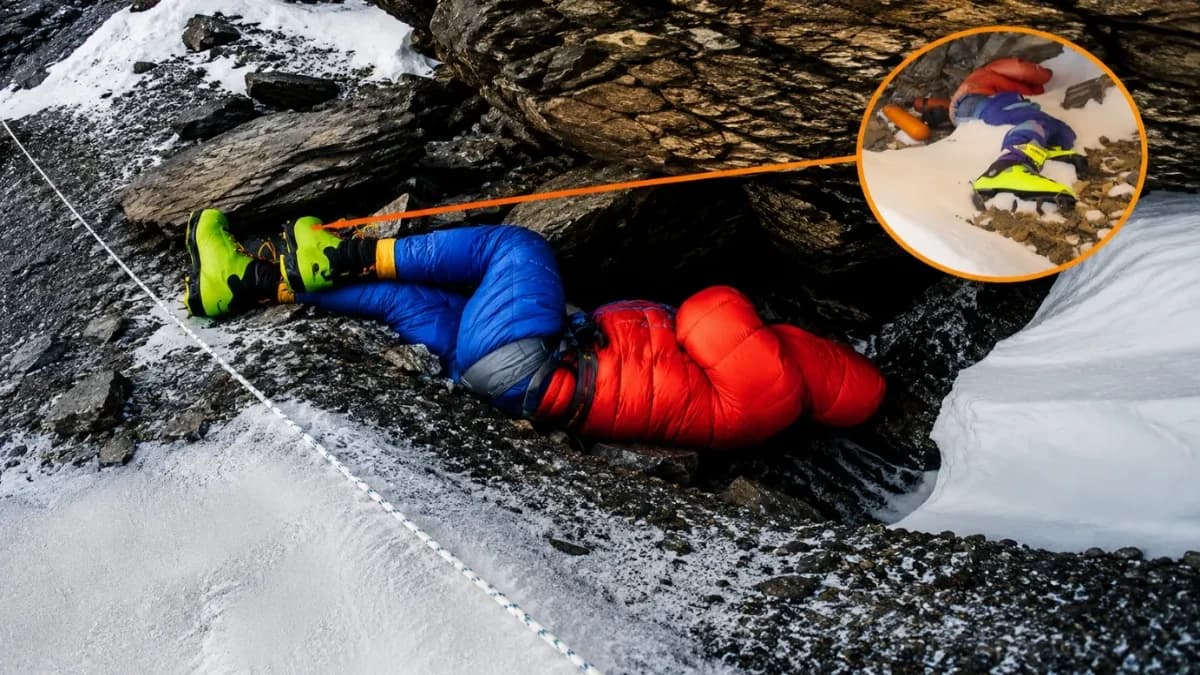
There's a name that every Everest climber on the north route knows. Not for any record. Not for any triumph. But for a pair of bright green boots sticking out of a limestone cave at 8,500 meters, frozen exactly where a man took his last breath in 1996.
The Green Boots of Mount Everest is the most haunting landmark the mountain has ever produced. A real person. A real death. And a story that the mountaineering world still can't fully agree on. This is the complete story of who he was, what happened on that mountain, and why his body stayed there for nearly 30 years.
Who Is Green Boots on Everest?
"Green Boots" is the nickname given to the frozen body of a climber found on Everest's Northeast Ridge, a man who died there in 1996 and never came down. The name came from one thing: a pair of bright green Koflach mountaineering boots.
At 8,500 meters, your mind narrows to what's directly in front of you. Most climbers passing through that stretch remembered only one thing about the figure in that cave: a pair of bright green boots.
For nearly two decades, this body lay curled inside a small limestone cave on the north side of Everest. Every expedition climbing from the Tibetan side passed directly by him. He became, without anyone planning it, a landmark on the route to the world's highest summit.
The body was widely believed to be Tsewang Paljor, an Indian climber and head constable with the Indo-Tibetan Border Police (ITBP). Later on, questions began to surface about whether that identification was ever truly correct.
A competing theory emerged naming Lance Naik Dorje Morup, another member of the same 1996 ITBP expedition, as the man actually lying in that cave. It's a debate that was never officially resolved and one that shapes everything about this story.
The Identity Mystery: Paljor or Dorje Morup?
Here's where things get complicated.
Most people and most evidence point to Tsewang Paljor as the man in the cave. The timeline fits. The boots fit. The location fits. But there's a second theory that has never fully gone away. P.M. Das, senior deputy leader of the ITBP expedition, published an article in the Himalayan Journal in 1997, arguing the body was actually Lance Naik Dorje Morup, not Paljor.
Here's what Das found. A Japanese expedition from Fukuoka encountered Morup alive between the first and second steps, badly frostbitten but conscious. They helped him onto the next fixed rope and then kept climbing. On their way back down, they saw him again crawling, barely moving, just below the First Step.
He was never seen again after that. Das believed Morup eventually collapsed near that stretch of the ridge and died in the cave alcove, which sits right along that section of the route. Paljor, by Das's theory, had fallen from the Kangshung Face entirely, leaving no body to find.
Nobody officially knows which theory is right. No formal identification. No forensic confirmation. At that altitude, a proper investigation is almost impossible, and after 30 years, the ambiguity hasn't moved an inch.
In June 2026, the Indo-Tibetan Border Police (ITBP) issued an official recovery tender identifying the body as his teammate, Lance Naik Dorje Morup. This isn't a guess. Government documents reveal a quiet 2024 mission gathered DNA from the remains.
The forensic verdict is official: "Green Boots" is Dorje Morup, solving a decades-old mystery just as plans begin to bring him home.
Who Were the Men Behind the Story?
Two men went up that mountain on May 10, 1996. Neither came back. And for nearly 30 years, the world couldn't agree on which one was lying in that cave.
Here's who they actually were.
Tsewang Paljor
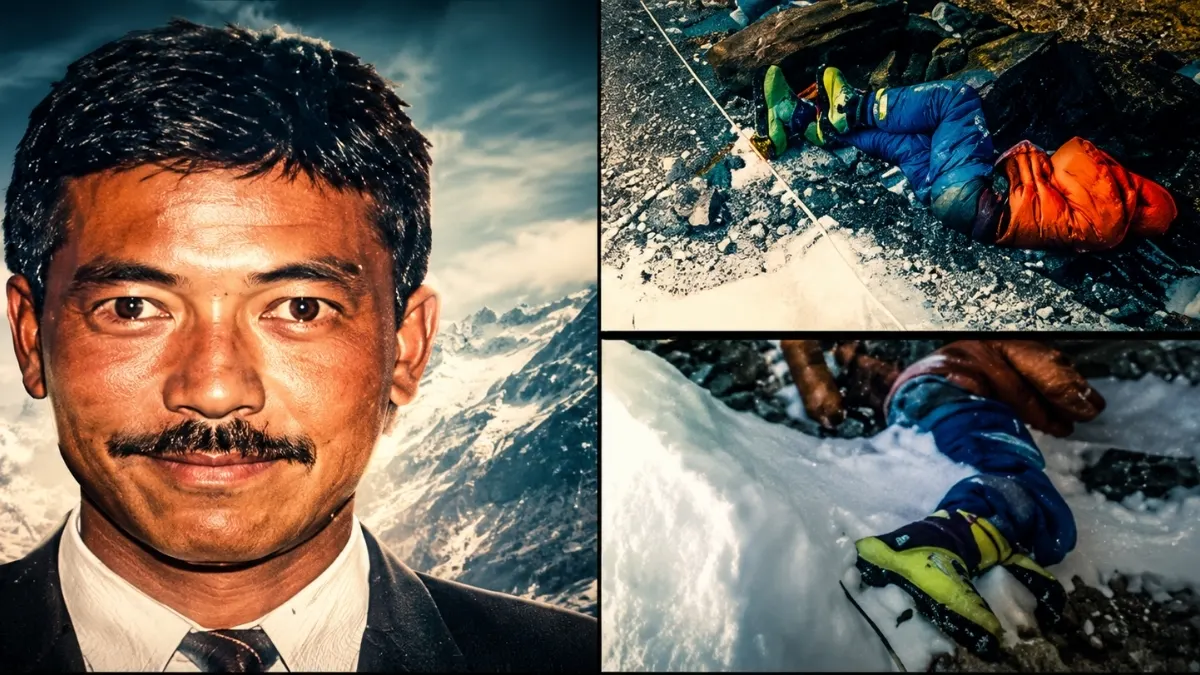
Whatever the truth turns out to be, one name has been tied to this story from the beginning. Tsewang Paljor was born on April 10, 1968, in Sakti, a small village tucked into the mountains of Ladakh, India. Growing up surrounded by peaks, mountains weren't just scenery to him. They were a calling.
He joined the Indo-Tibetan Border Police (ITBP), a force that patrols the 3,488 km India-China border across some of the most brutal high-altitude terrain on earth. This wasn't a desk job. It kept him at altitude, in harsh conditions, year-round.
So by the time Everest came into the picture, Paljor wasn't just a dreamer. He was trained, disciplined, and genuinely experienced at height.
He had already summited multiple peaks before 1996. This wasn't someone who decided to attempt Everest on impulse. He earned his place on that expedition. Away from climbing, he was quiet and simple. He never married.
He had a mother named Tashi Angmo and at least five siblings back home in Sakti. When the expedition left, his family waited for news. The news never came.
Dorje Morup
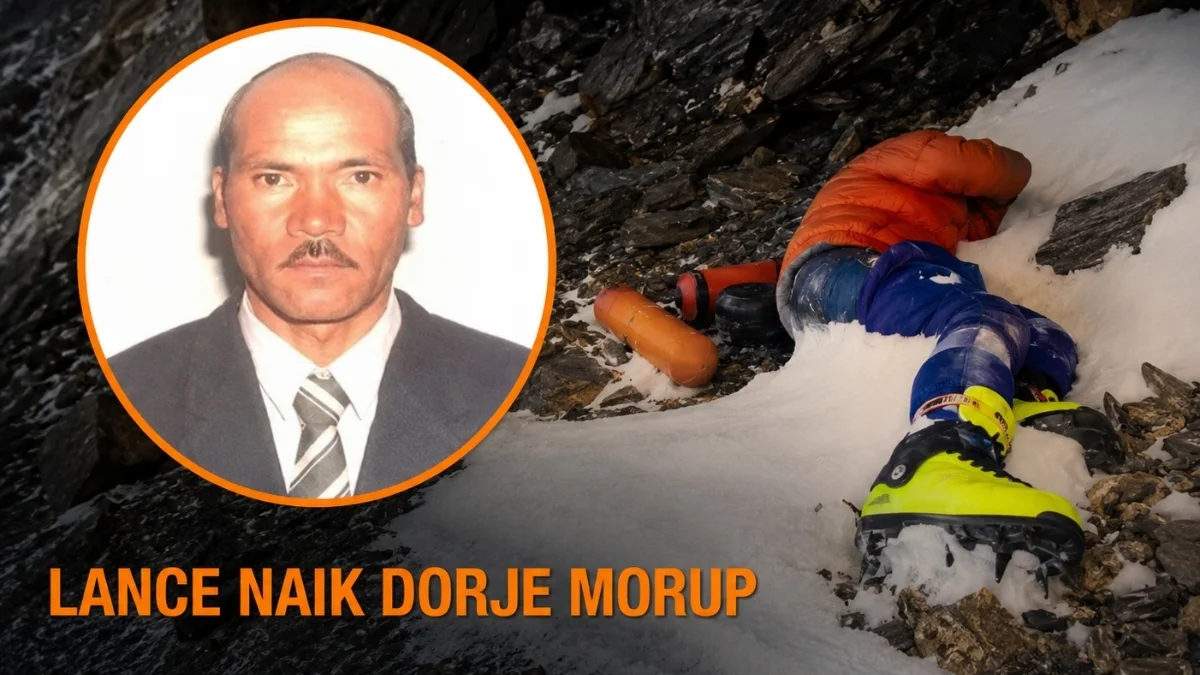
The other name in this story is Lance Naik Dorje Morup, and depending on who you ask, he may be the man actually lying in that cave. Born on October 1, 1948, Morup was a member of the same 1996 ITBP expedition. Older than his teammates, he was experienced, fierce, and completely committed to the climb. He hadn't come this far by accident.
On the night of May 10, 1996, a Japanese expedition from Fukuoka encountered him alive, conscious but badly frostbitten, barely moving between the First and Second Steps. They helped him onto the next fixed rope and continued climbing.
Later, fellow climbers reported seeing him lying under the shelter of a boulder close to Camp VI. He never moved from there.
He had a family back home waiting for him. They were people who never got a proper answer about what happened on that mountain. Whether the body in the cave belongs to Paljor or Morup, both men went up that mountain with everything they had.
Both men never came back. And for nearly 30 years, neither of them got to be more than a footnote in a story named after a pair of boots.
The 1996 Everest Expedition: What Actually Happened
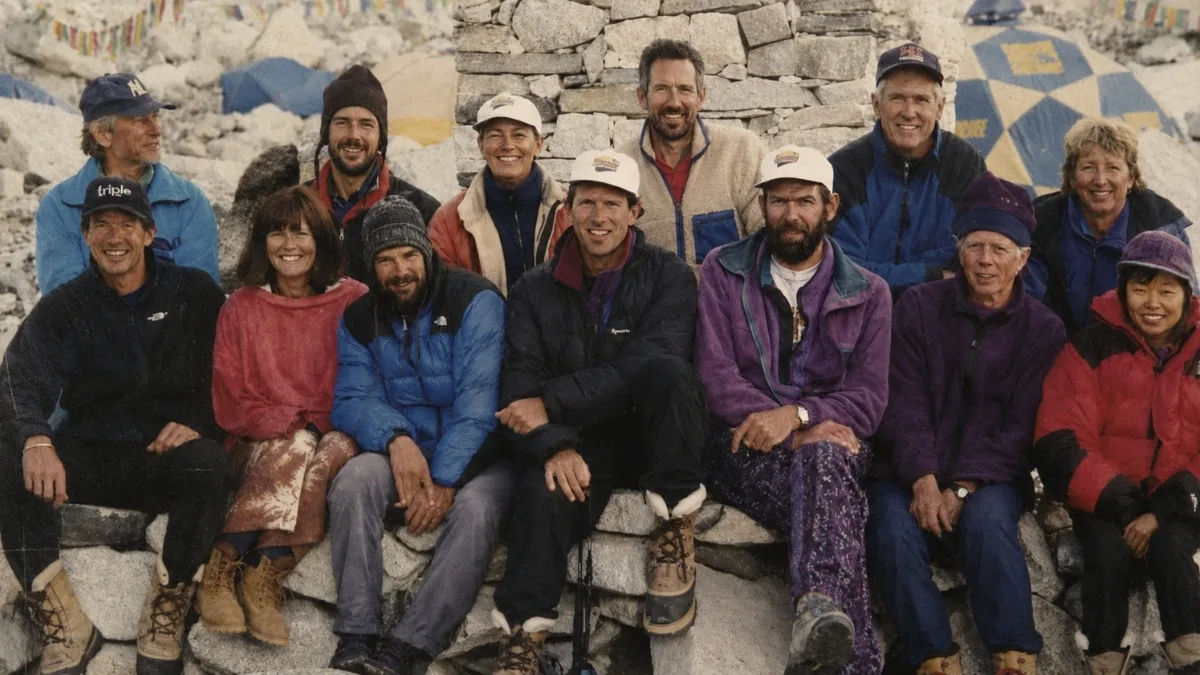
May 1996 is burned into mountaineering history. Eight climbers died across multiple Everest expeditions that season, most of them in a single catastrophic storm that nobody saw coming fast enough.
Paljor was part of a six-member ITBP team led by expedition leader Mohinder Singh. Their goal was to become the first Indians to summit Everest from the north side, climbing through Tibet rather than Nepal. A historic achievement, if they pulled it off.
As conditions began to deteriorate, three of the six made the call to turn back. The other three pushed on Subedar Tsewang Smanla, Lance Naik Dorje Morup, and Head Constable Tsewang Paljor.
The Final Hours
At around 3:45 PM on May 10, all three radioed their leader. They'd reached the summit. They left prayer flags and khatas at the top, the kind of offering you make when you think you've just done something historic.
Then the blizzard hit. Winds hit near-whiteout. Temperatures dropped below -30°C. At 8,500 meters with oxygen running low, the route down became nearly unnavigable. From lower camps, teammates watched two faint headlamps near the Second Step. Then the lights disappeared.
None of the three made it back. Worth noting the team hadn't hired Sherpas. Sherpas don't just carry gear. They read the mountain in ways no weather forecast can. Whether that changed the outcome, nobody knows. But it's never been forgotten.
Where Is Green Boots Cave?
Paljor's body came to rest in a shallow limestone alcove on the Northeast Ridge, at approximately 8,500 meters (27,900 feet) above sea level. The cave isn't dramatic; it's basically a small notch in the mountain's rocky face, barely big enough to crouch inside. But it became famous.
Climbers on the north route use fixed landmarks to track their progress because at that altitude, oxygen deprivation messes with your memory and judgment. Green Boots became one of those fixed points. Seeing those green boots meant you were above 8,400 meters and within a couple of hours of your summit push if everything went right.
Nearly every expedition on the north face stopped at or near that cave to change oxygen tanks and rest. So for years, hundreds of people literally sat next to a dead man to catch their breath. The cave was eventually named Green Boots Cave casually and informally by climbers who just needed to call it something.
Ready to Trek the Everest Region? The route where Green Boots rested is one of the most legendary trails on earth. Nepal Gateway Trekking offers expert-guided Everest treks with experienced local guides, no hidden costs, and packages built around your pace. Explore Everest Trek Packages
Ten Years Later, the Green Boots Cave Tragedy That Shocked the World
May 2006. Ten years after Green Boots died in that cave, it became the scene of a second death.
David Sharp, a British climber, was attempting Everest solo and on a tight budget, with no supplemental oxygen and a minimal support team. On his descent, he took shelter in Green Boots Cave. That's where climber Mark Inglis and his team found him hypothermic, barely conscious, and fading fast.
Inglis radioed base camp for guidance. The advice that came back, and the decision that followed, was to keep climbing. Sharp died hours later.
Here's the part that went worldwide.
Around 40 climbers passed David Sharp that day. Some apparently mistook him for Green Boots, the body they already knew was in that cave. Others saw a living man and kept walking anyway, calculating that stopping would risk their survival.
Sir Edmund Hillary, the first man to ever summit Everest, was openly furious. He didn't just criticize the decision. He called it a failure of humanity. He said the obsession with reaching the top had gone so far that basic human decency was being left at base camp.
The debate that followed was brutal and necessary. Should climbers risk their lives to help a stranger in the Death Zone? Is there a moral obligation when stopping might kill you too?
And what does it say about how commercialized Everest has become when dozens of people walk past a dying man because the summit is still an hour away? There are no clean answers. But the story forced people to ask the questions. And honestly, those questions haven't gone away.
What Happened to Green Boots After 2014?
After 2014, Green Boots was moved or buried by a Chinese expedition and has not been visible on the trail since. For years before that, every climber on the north route saw him. It was as reliable a landmark as anything on the mountain.
The most widely accepted explanation is that members of a Chinese expedition, likely from the China Tibet Mountaineering Association, which manages the Tibetan side of Everest, moved or buried the body for reasons never officially explained.
In 2017, some climbers reported seeing something in the cave again, this time covered by rocks. Whether that was Green Boots or not, nobody confirmed officially. As of recent years, the body is not visible on the trail. Out of sight at 8,500 meters isn't the same as recovered. On Everest, hidden and gone are two very different things.
India's 2026 Mission to Bring Green Boots Home
In June 2026, the ITBP officially issued a formal tender to hire a high-altitude recovery agency to retrieve the body, making this the closest anyone has come to actually bringing Green Boots home. The operation, if it goes ahead, must be completed within the June to September 2026 climbing window. Time is tight.
One detail stands out. The tender specifically names Dorje Morup as the identity of the body, not Tsewang Paljor. That's the ITBP itself, the organization that sent both men up that mountain now officially backing the Morup theory. The logistics are genuinely complex.
The body is in the Death Zone. Transport across the Tibet-Nepal border requires coordination with Chinese authorities. From there, the body will be flown to Kathmandu and then fully repatriated to India.
On the Nepal side, the army has been running annual high-altitude cleanup missions since 2019. In late 2025, Nepal announced a five-year Everest Cleaning Action Plan running through 2029, including trials of heavy-lift drones capable of carrying loads from high camps.
That kind of infrastructure makes recovery operations more realistic than they've ever been. Whether this particular mission succeeds, nobody knows yet. But after 30 years, a family in Ladakh might finally get an answer.
The Death Zone: What It Actually Does to the Human Body
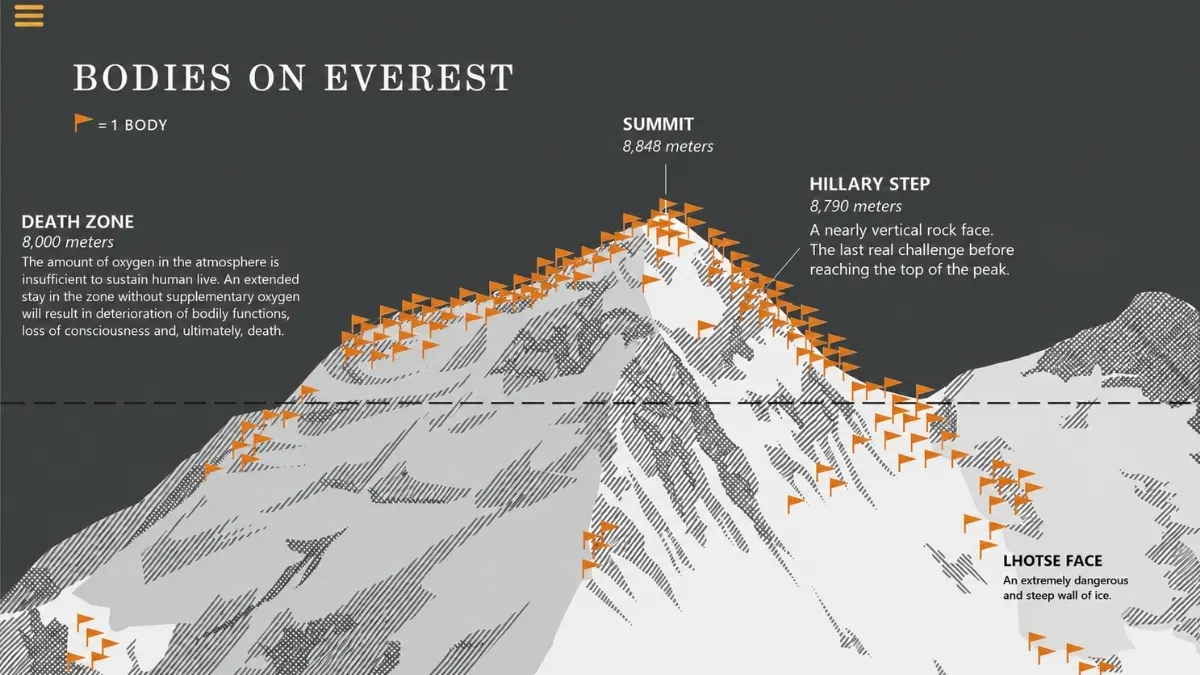
The Death Zone starts at 8,000 meters. Above this point, the human body can't acclimatize. It doesn't plateau. It just starts to deteriorate slowly, then fast. Climbers experience hypoxia, a dangerous drop in oxygen reaching the brain and muscles.
Judgment gets impaired. Memory starts failing. Simple tasks like clipping a carabiner or reading a compass become genuinely difficult. Hallucinations happen more than people admit.
On top of that, temperatures on the Northeast Ridge can drop below -40°C with wind chill. After days of climbing with minimal sleep and food, the body is already running on empty before the Death Zone even begins.
For Paljor and his team, they were operating in all of this at night, in a blizzard, with oxygen running low and no Sherpas to guide them back.
There's one more thing worth knowing. The cold that kills climbers also preserves them. Bodies at extreme altitude don't decompose the way they would anywhere else. The same brutal conditions that took Tsewang Paljor's life in 1996 kept him visible and largely intact for nearly 20 years.
That's why Green Boots became a landmark. Not because anyone chose it. But because the mountain simply wouldn't let him go.
Why Are Bodies Left on Everest?
This is probably the most common question people have. And it deserves a real answer, not a vague "it's complicated," but an actual breakdown of why.
-
The Altitude Makes Everything Harder: Above 8,000 meters, your body is actively shutting down. Carrying a frozen body isn't just difficult at that height. It's potentially lethal for the people attempting it.
-
The Cost Is Enormous: Recovery can cost anywhere from $80,000 to $700,000. Most families don't have access to that kind of money. And even when funding exists, success isn't guaranteed.
-
Weather Windows Are Brutally Short: Everest is only climbable during two narrow windows each year. If the weather turns, the operation stops. If the window closes, you wait another year.
-
The Terrain Is Unforgiving: Steep ice walls, exposed ridges, and unpredictable crevasses. Everything up there is harder by an order of magnitude than any rescue at lower altitude.
-
Legal and Diplomatic Hurdles: Any recovery on the Tibetan north side needs permission from Chinese authorities, Nepal, and relevant agencies on both sides. That process alone can take months.
So when people ask, "Why don't they just bring him down?" it genuinely isn't that simple. It's physics, money, weather, terrain, and politics all working against the same outcome.
Other Famous Bodies on Everest
Green Boots isn't alone. There are over 200 bodies on Everest, and a handful have earned their names.
-
Sleeping Beauty: Francys Arsentiev, who died in 1998 after summiting without oxygen. Her husband Sergei died trying to save her. Her body remained visible on the south side until 2007, when it was finally covered ceremonially.
-
The German Woman: Hannelore Schmatz, who summited in 1979 but died at 8,200 meters on descent. Her body remained on the south route for years, eventually blown further down the mountain.
-
Rainbow Valley: Not a person, but a section just below the summit on the north side, littered with colorful climbing gear and bodies from expeditions dating back decades. The name sounds almost pretty. It isn't.
Someone had a dream. They trained. They went. And Everest kept them.
Want to explore Nepal and its himalayan legends? Nepal Gateway Trekking offers trekking packages of different regions of Nepal and covers the real Himalayas: the history, the routes, the people, and the mountains behind the myths.
The Ethical Questions Nobody Has Fully Answered
These questions didn't start with Green Boots. But his story made them impossible to ignore.
Is it respectful to use a dead person's body as a trail marker?
- For years, Green Boots was literally referenced in guidebooks and expedition briefings as a distance marker. This is a strange kind of posthumous legacy for a 28-year-old from Ladakh.
Should climbers stop to help dying strangers in the Death Zone?
- The David Sharp case proved this isn't theoretical. And the answer isn't simple; stopping to help might mean adding your body to the mountain.
Who is responsible for body recovery? The family? The government? The climbing community? China? Nepal?
- Thirty years later, nobody has given a clean answer.
Has Everest become too commercialized?
- Jon Krakauer asked that question in Into Thin Air after the 1996 disaster. The 2015 film brought it to a new generation. The answer still hasn't changed. The mountain keeps producing the same questions. And keeps refusing to answer them.
Final Thoughts
Honestly, the story of Green Boots of Mount Everest isn't really about Everest. It's about what happens when a dream meets something bigger than itself. Tsewang Paljor or Dorje Morup, or whoever that man actually was, went up that mountain with everything he had. He trained for it. He committed to it. And the mountain didn't care.
What gets me is that for nearly 30 years, millions of people read about him, watched documentaries about him, and passed by him on the way to the summit and still couldn't agree on his name. The 2026 recovery mission feels important.
Not because it changes what happened, but because it finally treats him like a person instead of a landmark. His family deserves that. He deserves that.
Everest is incredible. It's one of the most remarkable places on earth. But it demands a kind of respect that goes beyond ambition, beyond summit fever, beyond that desperate need to reach the top.
The bodies on that mountain, green boots most of all, are the clearest reminder of what the mountain actually is. It doesn't reward bravery. It just is.
Thinking about the best view of Everest without climbing? Let's Plan It Together. Nepal Gateway Trekking is a Kathmandu-based trekking agency. Our team knows these routes personally. Plan Your Trek With Us
Frequently Asked Questions
Who is Green Boots of Mount Everest?
"Green Boots" is the nickname for a frozen climber found in a limestone cave at 8,500 meters on Everest's Northeast Ridge. The body is widely believed to be Tsewang Paljor, an Indian climber who died in the 1996 blizzard, though the ITBP's 2026 recovery tender names Dorje Morup as the identity.
Where exactly is Green Boots Cave?
It's located at approximately 8,500 meters (27,900 feet) on the northeast ridge of Everest, on the Tibetan (north) side. The cave sits just below the First Step on the climbing route.
Is Green Boots still on Everest?
The body has not been visible on the trail since around 2014. It's believed to have been moved or covered by Chinese mountaineers. As of 2026, India's ITBP has issued a formal tender to attempt a recovery.
Why was Green Boots never recovered before?
The combination of extreme altitude, dangerous terrain, massive cost, and legal/diplomatic complexity made recovery extremely difficult. No family or government had previously committed to an official operation until 2026.
Did Green Boots reach the summit of Everest?
The three ITBP climbers radioed that they had reached the summit just before the storm hit. However, some evidence suggests they may have turned back around 150 meters short due to poor visibility. It remains disputed.
Who was David Sharp, and what does he have to do with Green Boots?
David Sharp was a British solo climber who took shelter in Green Boots Cave during his descent in 2006 and died there. Around 40 climbers passed him, some mistaking him for Green Boots. His death sparked a major ethical debate about the responsibilities of climbers in the Death Zone.
How much does it cost to recover a body from Everest?
Recovery operations in the Death Zone can cost anywhere between $80,000 and $700,000 depending on the location, equipment needed, and support required.
Does Green Boots have family?
Yes, Dorje Morup left behind an extended family in India's Ladakh region, and the primary goal of the 2026 recovery mission is to return his remains to his relatives for traditional religious rites.
When did Green Boots die?
Green Boots is believed to have died on the night of May 10–11, 1996, during a catastrophic blizzard that struck Everest's Northeast Ridge.