Set behind the historic mud walls of Lo Manthang, the last walled capital of the ancient Kingdom of Lo, the Tiji Festival happens every spring, and nothing quite prepares you for it. Not the long jeep ride up the Kali Gandaki Gorge. Not the permit paperwork.
Not even the photos you've seen online. The locals don't call it Tiji. To them, it's "Tenchi," a shortening of the classical phrase "Tenpa Chirim," which translates to "Prayer for Universal Peace." These three words have endured for centuries.
This isn't a cultural show staged for outsiders. Families walk for days across windswept passes to get here. They've been doing it for generations.
The ritual has been running continuously since the 17th century, when King Samdup Rabten brought the revered Sakya master Ngawang Kunga Sinam to Lo Manthang to purify the walled city after a series of natural disasters.
Every drum crack and every low horn note you hear in that courtyard carries that history inside it.
Quick Answer
The Tiji Festival is a three-day Tibetan Buddhist festival held annually in Lo Manthang, Upper Mustang, Nepal. Known locally as Tenpa Chirim (Tenchi), meaning "Prayer for World Peace," it reenacts the legendary battle between Dorje Jono and the demon Man Tam Ru through sacred Cham dances performed by monks from Choedhe Monastery.
Celebrated in May or June, according to the Tibetan lunar calendar, the festival symbolizes the triumph of good over evil and remains one of the most important living traditions in the ancient Kingdom of Lo.
What Tenpa Chirim Actually Means and Why It Still Pulls People Across the Mountains?
The Tiji Festival is a Tibetan Buddhist festival at its core, but it is more than ceremony. Tenpa Chirim is a living petition, a collective wish for harmony made physical through three days of masked dance, communal gathering, and ritual destruction of evil.
You feel it the moment you step inside the city walls and realize that the entire medieval settlement has essentially become the stage.
The stone courtyard in front of the king's palace is where it all unfolds. And the city itself, the narrow lanes, the whitewashed walls, and the monastery rising above it all are not a backdrop. It is part of the prayer.
The Ancient Legend of Dorje Jono That Drives Every Step of the Lo Manthang Tiji Festival
The story behind the dances is not abstract mythology. When you understand it, the whole festival makes sense. The enemy is Man Tam Ru, a demonic entity who, according to local lore, was the direct cause of the region's worst catastrophes. He dried up the rivers. He killed the barley crops. He starved the kingdom.
The hero is Dorje Jono, the wrathful deity known in Vajrayana Buddhism as Vajrakila or Vajra Kumara, who takes on this demon in a confrontation so fierce it takes three full days to reenact. Every masked dance, every stomp, every ritual sequence across those three days is a chapter of that confrontation.
When the final sequence ends on the third afternoon and the demon is symbolically destroyed, the relief you feel in the crowd is completely real. People exhale. Some cry. The story lands.
Ready to explore Upper Mustang? Our local experts can help with permits, itineraries, and trip planning. Contact Nepal Gateway Trekking today.
The Preparations Behind the Tiji Festival
Most visitors only see the public performance. What happens inside Choedhe Monastery in the weeks leading up to it is a different level of commitment entirely.
The Monk Who Disappears for Three Months to Become the Deity
The spiritual weight of the Lo Manthang Tiji Festival falls on one monk, the Tsowo, the chief dancer chosen to embody Dorje Jono. The high lamas of Choedhe Monastery select him carefully. Once chosen, he enters a three-month solitary retreat. No human contact.
Nothing but mantra recitation and mental purification. By the time he steps into the courtyard on the opening day, he is not performing a role. He is carrying a deity.
Where the Cham Dance Goes From Movement to Physical Prayer?
While the Tsowo is in retreat, the rest of the monks at Choedhe Monastery are in training. Cham dance is not stage choreography. It is exhausting, precise, and weighted with meaning every footstep, every mudra, and every turn is dictated by ancient silk manuals.
The inner courtyard of the monastery echoes with stomping boots for weeks. These monks are both athletes and priests.
Butter Sculptures Built to Trap a Demon
A separate team of monastic artists works quietly during this same period, sculpting Torma offerings from roasted barley flour and colored yak butter. Cold-handed, patient work.
These figures serve two purposes: they honor the protective deities, and they are designed to act as spiritual containers absorbing and trapping the chaotic energy of Man Tam Ru before the final destruction.
Masks That Are Treated Like Living Things
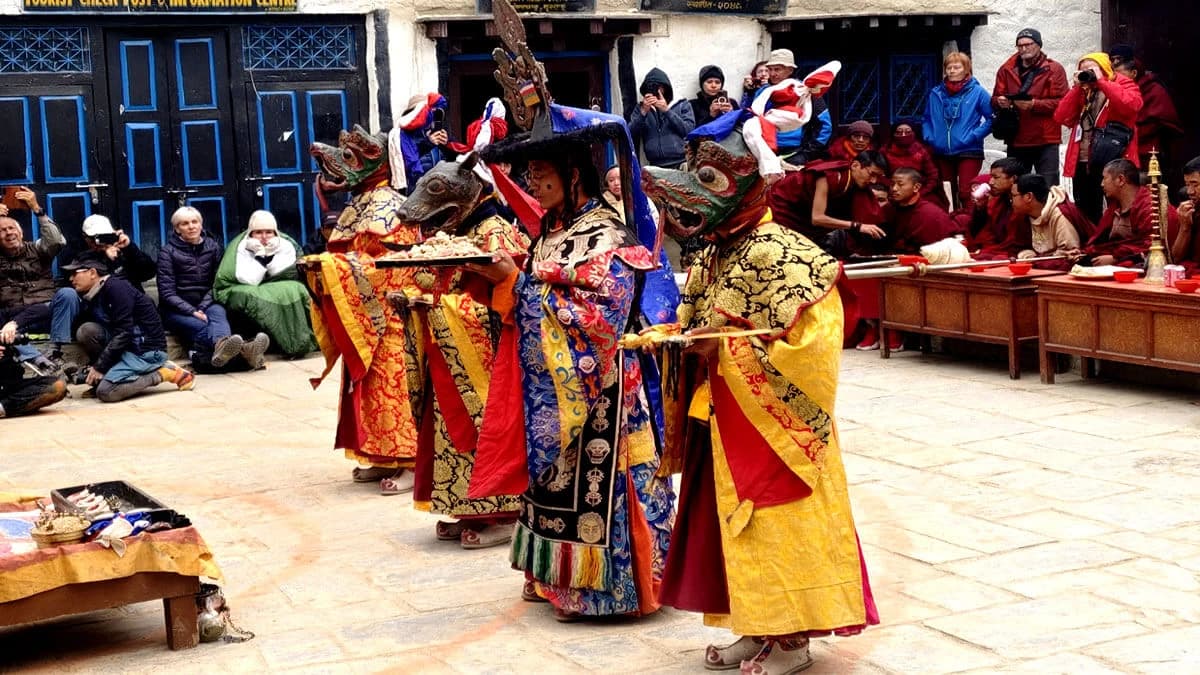
The sacred wardrobe comes out last. The monks unpack antique silk robes and large wooden masks of snow leopards, stags, and eagles, each one representing a deity from the Vajrakila mandala. Before a single mask touches a monk's face, it goes through rounds of cleansing rituals and blessings.
These are not costumes. They are treated as living sacred objects, and the distinction matters.
When to Go to the Tiji Festival Upper Mustang: Dates for the Next Three Years
The Tiji Festival Upper Mustang schedule runs on the Tibetan lunar calendar, which means the dates shift every year relative to the Gregorian calendar. They usually land somewhere in May or June. Here are the confirmed upcoming dates:
- 2026: May 13, 14, and 15
- 2027: June 1, 2, and 3
- 2028: May 21, 22, and 23
That shifting calendar isn't an inconvenience it's actually appropriate. The entire rhythm of life in Upper Mustang has always been tied to seasonal cycles. The festival follows the same logic it always has.
Planning your journey to Upper Mustang? Explore our complete Upper Mustang Trek Guide to learn about permits, costs, itinerary options, and essential travel tips before you go.
Three Days in the Palace Courtyard: What the Lo Manthang Tiji Festival Actually Looks Like
The three-day arc of this Tibetan Buddhist festival moves from tension to battle to release. Here's what each day actually feels like on the ground.
Day One Tsa Chham: The Horns Wake Up the Valley
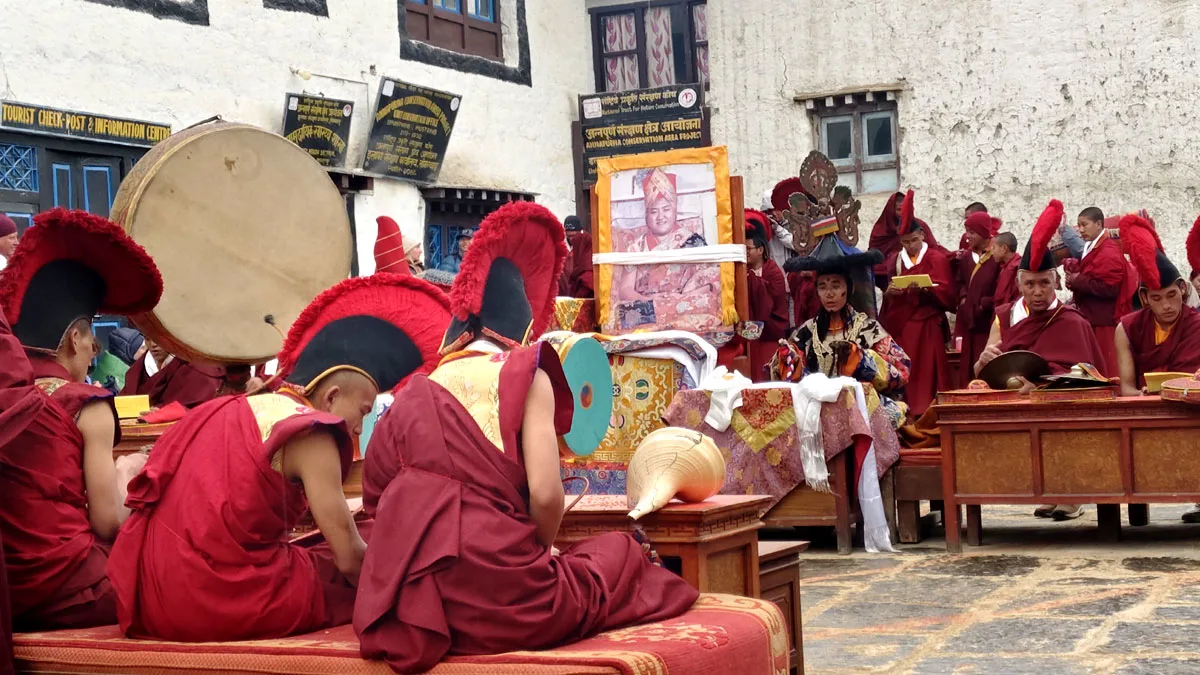
The opening sequence of the Lo Manthang Tiji Festival begins before you even get to the courtyard. Monks climb to the flat roof of Choedhe Monastery and blow the Dhungchen massive copper horns, whose low, resonant calls travel across the entire valley. You feel it before you hear it clearly.
Down in the square, the Arham purification dance opens the ground-level ceremonies, clearing out negative energy before the main figures arrive. The mood on day one is deliberately heavy and unsettling the dances reenact the early terror of Man Tam Ru.
The emotional peak arrives when a 400-year-old silk thangka is unfurled down the southern wall of the square, exposing Guru Rinpoche in vivid color to the mountain air while the monks chant. Standing in that square watching it happen is not something you shake off quickly.
Day Two: Nga Chham, the Battle Peaks and the Village Women Arrive
The second afternoon is louder. Faster. The drums pick up pace, the choreography becomes aggressive, and the Cham dance sequences on this day show Dorje Jono actively wrestling the demon's power into submission.
Monks spin in heavy robes and animal masks physically demanding work that makes it obvious why weeks of training are required.
And then the local women arrive. Dressed in sheepskin capes, wearing heavy heirloom pieces of turquoise, coral, and amber, they form a circle around the square's perimeter. Their presence transforms the atmosphere.
The battle in the center, the women watching from the edges, the drumbeats rolling across the square. That image stays with you.
Day Three Rha Chham: The King Appears and the Demon Gets Destroyed
The final day opens with something rare, a formal public appearance by the cultural king of Lo in full royal robes, joining the high lamas to offer blessings. The bond between leadership and spiritual tradition in this kingdom is ancient, and seeing it made visible is striking.
Then comes the climax. The massive barley-and-butter Torma effigy, which serves as the demon's physical stand-in, is carried out of the palace square in a procession that can only be described as controlled chaos. Muskets fire. Horns blow. The crowd presses forward.
The procession moves out past the city gates, and there the lamas destroy the effigy with a ceremonial weapon and scatter it into the desert dust. The demon is gone. The water will flow. The land is safe for another year. Every person in that field knows exactly what just happened.
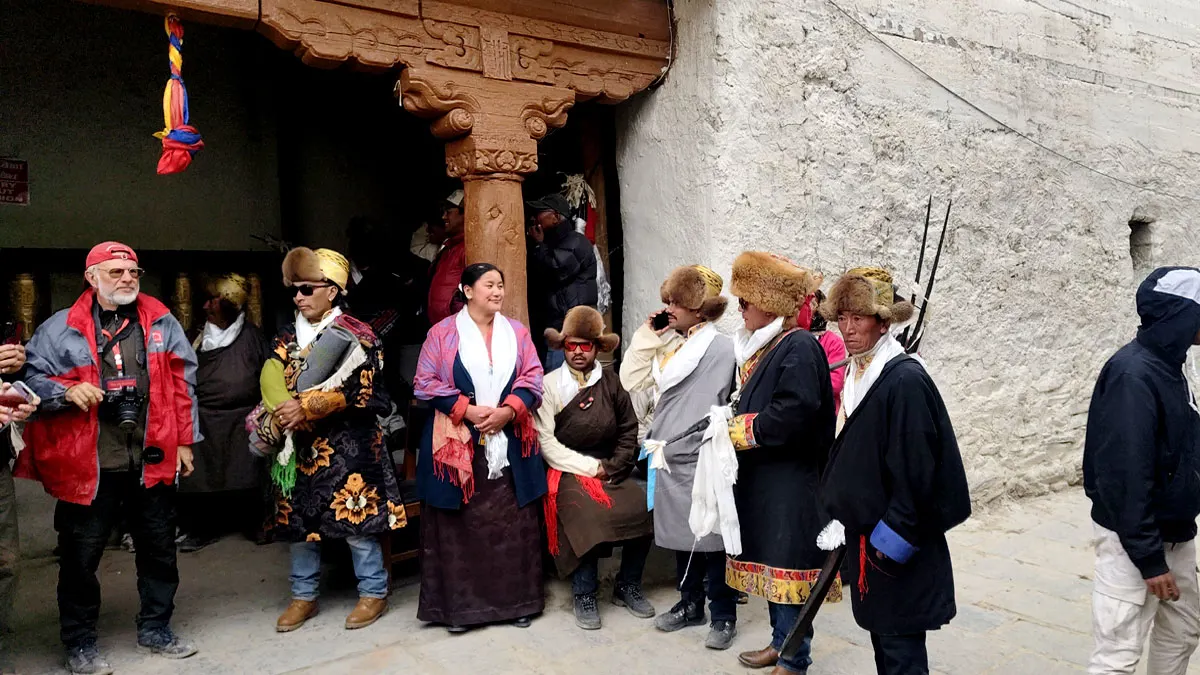
Where to Stand During the Tiji Festival: Positioning That Actually Makes a Difference
The main courtyard in front of the King's Palace is the center of all three days. Getting there early matters space fills up fast, and you don't want to be the person blocking a local family's view with a camera bag.
The best elevated position is a rooftop. If you can get permission from a local family, the flat mud-plastered rooftops surrounding the square give you a bird's-eye view of the geometric patterns the Cham dance creates from above, something you simply cannot see from ground level.
Outside the square, the quiet morning alleyways are worth your time on all three days. You'll see families in traditional dress catching up with relatives they only see once a year. And on the final afternoon, get yourself out to the open fields just north of the city walls.
That's where the exit procession passes, providing the best vantage point for watching the demon effigy leave Lo Manthang for the last time.
How to Be a Decent Guest at a 400-Year-Old Sacred Ceremony?
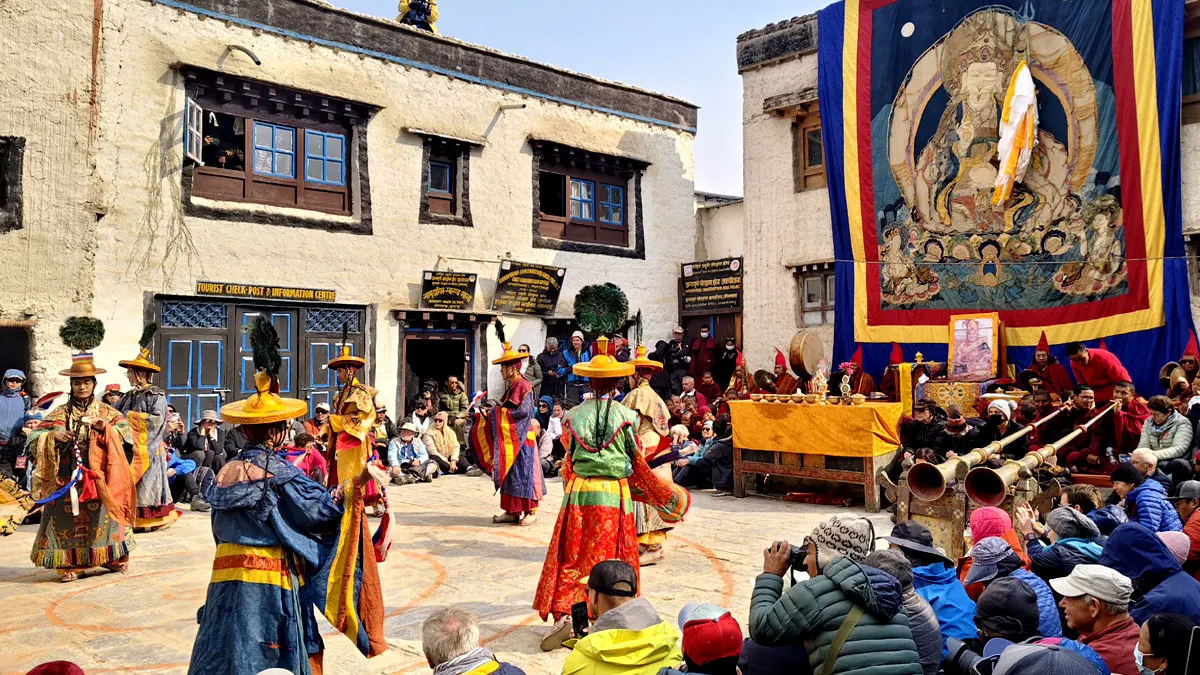
The Tiji Festival is a living religious ceremony. Not a performance. Not a cultural attraction. A few things to remember:
- Cameras: Don't photograph inside prayer chapels. Don't push a long lens into a meditating monk's face. During the dances, check that your tripod or camera bag isn't sitting in someone's sightline. The people around you traveled days to be there.
- Dress: Shoulders and knees covered in the palace square and anywhere near the monastery. Shoes and hats off inside temple chapels every time.
- Direction: Walk clockwise around monasteries, stupas, and mani walls. This is the standard Buddhist sign of respect. It's a simple habit to pick up.
- Distance: Don't touch the dancers, the masks, the torma offerings, or monks in active processions. Watch closely. Keep your hands to yourself.
- Trash: Upper Mustang has no waste infrastructure. Every wrapper, battery, and piece of plastic you bring in, you carry back out to Kathmandu. Non-negotiable.
Ready to witness the Tiji Festival in person? Join our Upper Mustang trek journey and experience Lo Manthang's most sacred celebration alongside local communities.
Other Festivals in Mustang Worth Planning Around
The Tiji Festival Upper Mustang calendar gets the most international attention, but the region runs deep with other ancestral celebrations throughout the year.
Yartung Horse Racing, Archery, and the End of Summer
Every August, the high pastures of Upper and Lower Mustang fill up for Yartung, the harvest celebration. Muktinath and Lo Manthang both host large gatherings. Wild horse racing across the valleys, archery tournaments, singing, and local food are all part of the festivities.
The young men and women of Mustang use the festival as the moment to show off horsemanship skills that have been refined over generations before the winter cold closes everything down.
Dumji, a Week of Feasting to Honor Guru Rinpoche
Dumji is celebrated primarily by communities with Sherpa and Tibetan roots. Held in early summer, it honors the birth of Padmasambhava and runs for a full week of serious religious ceremonies mixed with community feasting and laughter. Village lamas perform dances to clear seasonal bad luck, and local families take turns hosting.
Saga Dawa, the Holiest Day of the Year
On the full moon of the fourth lunar month, usually May or June, Tibetan Buddhists observe Saga Dawa, the day honoring the birth, enlightenment, and passing of Gautama Buddha. Locals spend the day circumambulating holy sites, lighting yak-butter lamps, donating to the poor, and releasing captive animals. The belief is that any act of merit on this day carries millions of times the normal karmic weight.
Losar Sweeping Out the Old Year
Losar, the Tibetan New Year, arrives in February or March. Homes get scrubbed down to the corners to sweep away the previous year's bad luck. Then the actual celebration family reunions, fresh prayer flags on rooftops, bowls of Guthuk noodle soup, and blessings from elders and lamas. Warm, loud, and deeply family-oriented.
Why the Tiji Festival in Upper Mustang Still Runs Exactly the Way It Always Has?
What's most remarkable about the Tiji Festival is how untouched it is. The monks of Choedhe Monastery are not performing for an audience. They are fulfilling a sacred obligation passed down lineage-to-lineage for centuries, with no modifications, no shortcuts, and no dilution.
And this isn't just a Lo Manthang event. The Tiji Festival Upper Mustang celebration draws the Lo Chhodun, the seven traditional provinces of the region, together in the capital. Families navigate canyons and cross high passes to get here.
The prayer for peace encoded in Tenpa Chirim isn't ceremonial language. It is the reason every single person in that courtyard showed up.
Final Thought
The Tiji Festival doesn't reveal itself all at once. It builds from the first horn blast on the monastery rooftop to the final scatter of demon dust outside the city gates. By the end of the third day, you've followed a complete story: catastrophe, confrontation, victory, and peace restored.
And you've watched it unfold in the same courtyard, performed for four centuries by the same community that has kept it alive.
Want to explore the ancient world of the forbidden kingdom? Step through the gates of Upper Mustang with Nepal Gateway Trekking and experience one of the most culturally intact destinations left on Earth.
FAQs
What does the word "Tiji" actually mean?
"Tiji" is an informal shortening of "Tenchi," which itself abbreviates the classical Tibetan phrase "Tenpa Chirim," meaning "Prayer for World Peace." That core intention, bringing balance and harmony to the universe, is what the entire three-day ceremony is built around.
Where exactly does the Lo Manthang Tiji Festival take place?
All ceremonies take place in the open stone courtyard directly in front of the historic King's Palace inside the walled city of Lo Manthang, in the restricted Upper Mustang region of northern Nepal. The monks of Choedhe Monastery perform the Cham dance sequences exclusively.
What is the story the dances are telling?
The festival reenacts the battle between Dorje Jono, the wrathful Buddhist deity Vajrakila, and a demon named Man Tam Ru, who caused catastrophic droughts and crop failures across Mustang. The three days show the battle and the demon's ultimate defeat.
How many days does the Tiji Festival run?
Three days, each with its own ritual character. Day one is Tsa Chham the demon's terror arrives. Day two is Nga Chham, the battle reaches its peak. Day three is Rha Chham's victory, the destruction of the effigy, and peace restored.
When does the Tiji Festival happen each year?
Dates are calculated on the Tibetan lunar calendar and shift annually. Upcoming confirmed dates: May 13–15, 2026; June 1–3, 2027; May 21–23, 2028.
What permits do I need to attend?
Independent trekking in Upper Mustang is strictly prohibited. You must book through a registered Nepali trekking agency, travel in a group of at least two, and hire a licensed local guide. Required permits include a Restricted Area Permit (RAP) at $50 USD per person per day, plus an Annapurna Conservation Area Project (ACAP) permit.