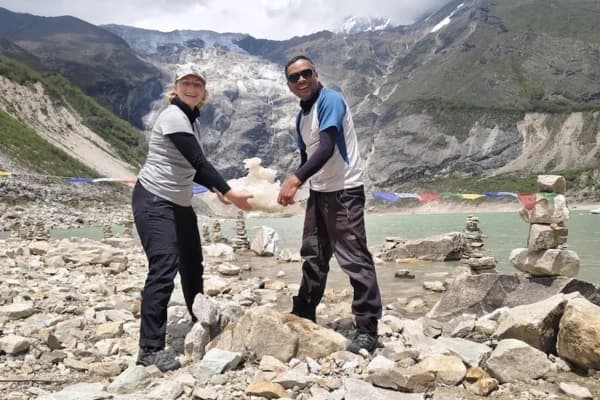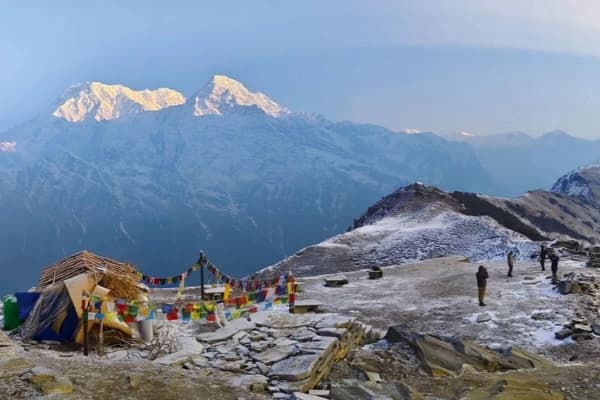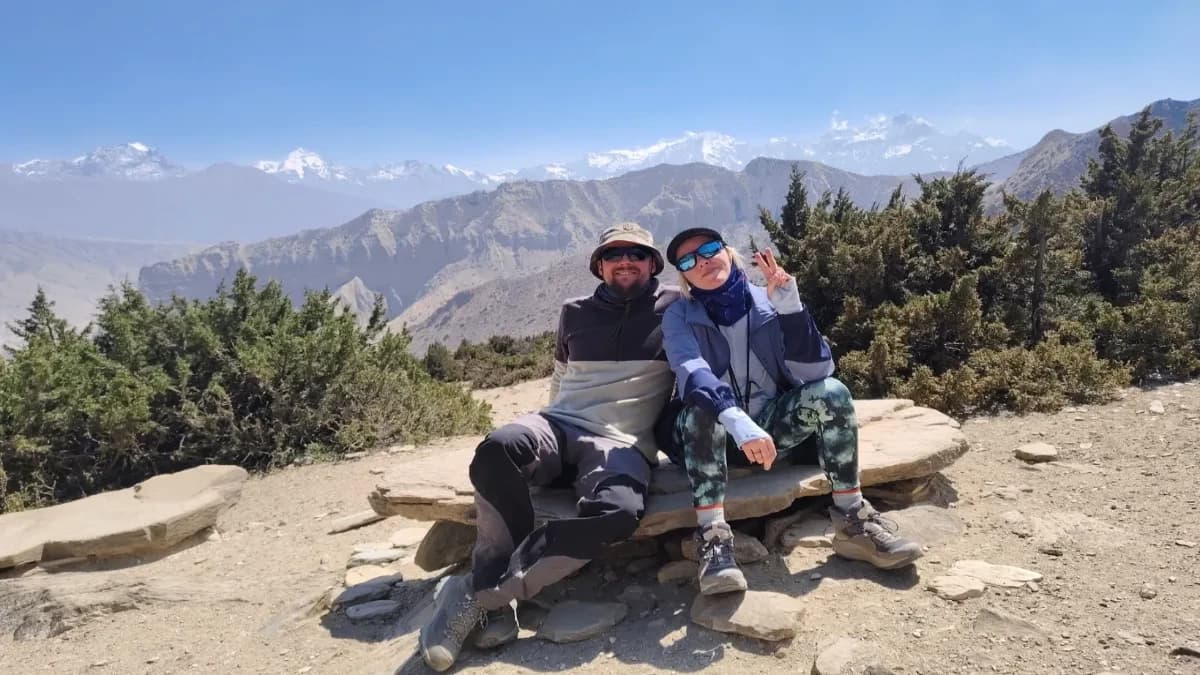
When Nepal’s monsoon arrives in July and August, the most popular trekking routes get wet and muddy and are susceptible to landslides. Heavy rain, poor visibility, and frequent travel disruptions are common on routes such as Everest Base Camp and Annapurna Base Camp.
But there is one Himalayan destination that gives you a whole different experience and that is Upper Mustang Trek.
North of the Annapurna and Dhaulagiri ranges, Upper Mustang is in the rain shadow of the Himalayas. The region’s unique geography blocks most monsoon clouds from reaching it, leaving it mostly dry even at the peak of the rainy season.
Instead of muddy forest trails, you will hike dramatic desert landscapes, deep canyons, colorful cliffs, ancient Tibetan villages, and centuries-old monasteries under clear blue skies.
One of the best monsoon treks in Nepal is the Upper Mustang Trek in July and August. Fewer crowds, pleasant daytime temperatures (15-25°C), great photo opportunities, and authentic cultural experiences make the Upper Mustang Trek a great option for trekkers who want to experience the Himalayas without the usual monsoon hassles.
Before you start planning your trek, read this complete guide to everything you need to know about weather, trail conditions, permits, transportation, costs, packing tips, itinerary recommendations, and expert travel advice to help you enjoy a safe and unforgettable journey through Nepal’s legendary Forbidden Kingdom.
Quick Review
-
Upper Mustang is one of Nepal's best monsoon trekking destinations because it lies in the Himalayan rain shadow and remains mostly dry in July and August.
-
July and August offer warm weather (18–25°C), clear skies, green landscapes, and fewer crowds, making them ideal months to visit.
-
August is especially popular for the Yartung Mela Festival, where visitors can experience traditional horse racing, Tibetan culture, and local celebrations.
-
The trek takes 10–14 days, reaches a maximum elevation of 3,840 m (Lo Manthang), and is considered moderately difficult.
-
A Restricted Area Permit (RAP), Annapurna Conservation Area Permit (ACAP), and a licensed guide are mandatory for all trekkers.
-
Solo trekking is now permitted (2026 rules), provided you book through a registered trekking agency and hire a government-licensed guide.
-
Top highlights include Lo Manthang, Chhoser Sky Caves, Tsarang Palace, Kagbeni, and ancient Tibetan monasteries, offering a unique combination of culture, history, and dramatic landscapes.
-
Pack for wind and strong sun rather than heavy rain, and plan extra buffer days due to possible monsoon-related flight delays between Pokhara and Jomsom.
-
Upper Mustang is ideal for photographers, cultural travelers, and anyone looking for a reliable Himalayan trek during Nepal's monsoon season.

Upper Mustang Trek in July and August At a Glance
|
Detail |
Information |
|
Best Months |
July & August (Peak Rain-Shadow Season) |
|
Trek Duration |
10–14 Days |
|
Difficulty |
Moderate |
|
Maximum Elevation |
3,840 m (Lo Manthang) |
|
Daytime Temperature |
18°C to 25°C |
|
Night Temperature |
0°C to 8°C |
|
Rainfall |
Extremely Low — under 200mm annually |
|
Permits Required |
RAP + ACAP |
|
Guide Requirement |
Mandatory Government-Licensed Guide |
|
Best For |
Tibetan Culture, Photography, Monsoon Escape |
Planning your trek? Explore our detailed Upper Mustang Trek itinerary, package inclusions, and updated pricing to find the right adventure for your schedule.
Why Upper Mustang Stays Dry During Nepal's Monsoon?
Upper Mustang sits behind one of the most effective natural rain barriers on earth. Monsoon air from the Bay of Bengal sweeps northwest and slams into the Annapurna and Dhaulagiri walls, both above 8,000 meters. The air is forced up, cools rapidly, and dumps every drop of moisture on the southern slopes. That's why Pokhara is one of the wettest cities in South Asia.
By the time those same air currents cross the peaks and drop into the Kali Gandaki valley, they're bone-dry. Upper Mustang gets under 200mm of rain per year. For comparison, that's less than Cairo.
That's the rain shadow. And it makes the Upper Mustang Trek in July and August one of the best Nepal rain shadow treks and one of the only high-altitude walks in South Asia that genuinely improves in monsoon season.
Upper Mustang Weather in July vs. August
Both months are excellent for trekking north of Kagbeni. The differences are real but small.
July Weather
Cross the Kagbeni checkpoint in July, and the first thing you notice is the color. The canyon walls are still dry ochre and rust-red, but the valley floors are carpeted in vivid green barley and buckwheat plots irrigated by channels dug centuries ago.
Daytime temperatures sit around 20–25°C. You'll trek comfortably in a single shirt until about 11:30 AM, when the Kali Gandaki wind kicks in with considerable force Mornings are the best time to be on trail calm, clear, and cold. Crowds are at their absolute yearly low. You'll walk into 600-year-old gompas and be the only person there.
August Weather
August is nearly identical to July weather-wise. Air is slightly cleaner brief evening drizzles settle the trail dust that builds through July. Nights are a touch cooler, around 4–8°C, so a proper fleece matters.
The big difference is cultural. August brings the Yartung Mela festival trek, the single most important cultural event in the Mustang calendar. If you can time it right, mid-August is the best week of the year to be here.
July vs. August Comparison
|
Weather Metric |
July |
August |
|
Daytime Temp |
20°C to 25°C |
18°C to 24°C |
|
Nighttime Temp |
5°C to 9°C |
4°C to 8°C |
|
Rainfall |
Very low rare evening drizzle |
Very low, slightly cleaner air |
|
Wind |
Strong from 11:30 AM daily |
Strong from 11:30 AM daily |
|
Crowds |
Extremely low |
Low to moderate around festival week |
|
Highlight |
Green fields, empty trails |
Yartung Mela horse racing |
Why July and August Are the Best Months for the Upper Mustang Trek?
Most people discover treks in Nepal's rain shadow, like Upper Mustang, by accident; they couldn't travel in autumn, looked for alternatives, and found Mustang. What surprises them every time is how much summer actually offers over the popular seasons.
The fields have color. Come in October, and the valleys are bare and dust-grey. In July and August, terraces of bright green barley run right up against crimson canyon walls. That contrast simply doesn't exist any other time. No one else is here. Most trekkers assume that all of Nepal shuts down during the monsoon.
They're wrong about Upper Mustang, and their assumption works in your favor. You'll have entire monastery halls to yourself. Days are genuinely warm. Mustang winters are brutal below -10°C at night, with most Loba families migrating south.
July and August sit at a comfortable 20–25°C during the day. The Yartung Mela festival trek is only possible in August. Nothing else in the trekking calendar comes close to it culturally.
How to Reach Upper Mustang in July and August?
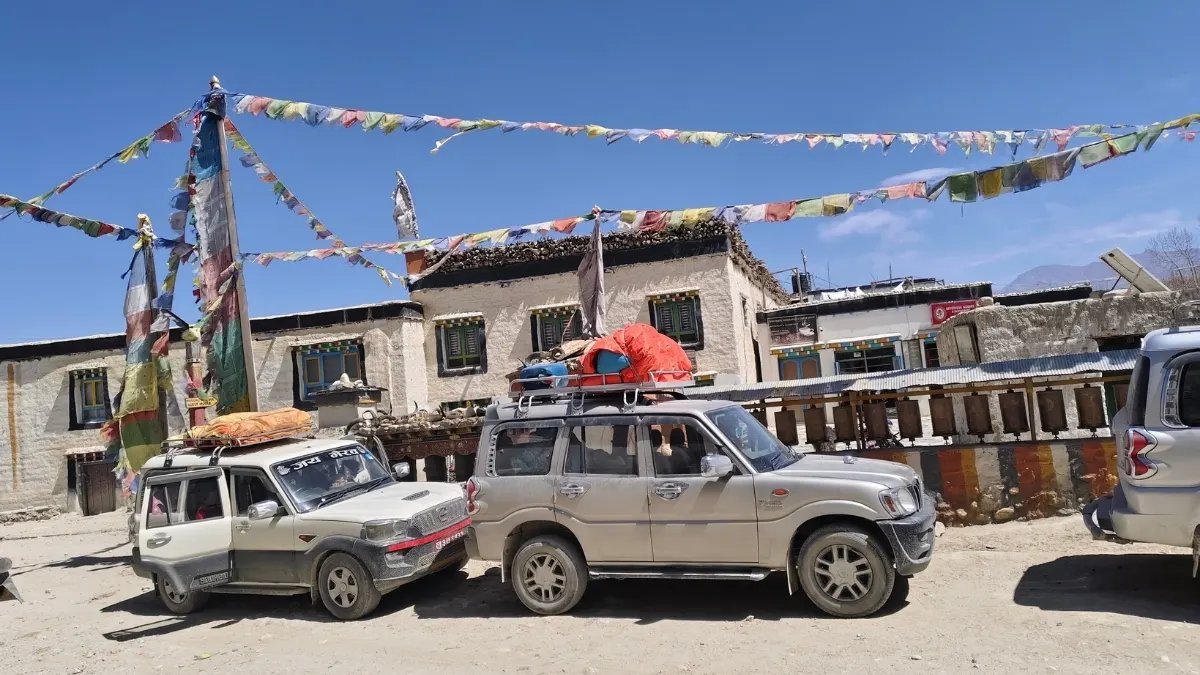
You have two realistic options. Both start from Pokhara.
- Option 1: Flight Pokhara to Jomsom (20 minutes)
Spectacular aerial views of Annapurna and Dhaulagiri. But in July and August, treat this as a bonus if it flies not a reliable plan. Always book with a confirmed jeep backup.
- Option 2: Private 4WD Jeep Pokhara to Jomsom (7–9 hours)
Bumpy through the lower gorge sections, but highly reliable. You get the full ecological transition from subtropical forest to alpine desert in one drive. For the Upper Mustang Trek in July and August, the Jeep is the dependable choice.
Top Places to Visit on the Upper Mustang Trek in July and August
Upper Mustang isn't a viewpoint trek. It's a living archaeological site where people still actually live.
Lo Manthang
Founded in 1380 by Ame Pal, Lo Manthang is a walled city of roughly 1,000 Loba residents surrounded by a continuous 6-meter earthen wall that's never been rebuilt. Step through the single gate and you're inside a medieval city. In July and August, the surrounding barley fields outside the wall are fully green; the contrast with the white walls and blue sky is striking.
Chhoser Sky Caves
Hand-carved chambers 50–150 meters up sheer clay cliffs, some dating back over 2,000 years. Archaeologists found human remains, ancient manuscripts, and Bronze Age tools inside. Nobody fully understands how the people who built them accessed them without modern climbing gear.
Tsarang Palace and Gompa
A five-story ruined palace teetering on the lip of a 300-meter canyon. Inside the attached gompa, brass-and-gold-ink manuscripts sit exactly as they were left centuries ago. You should give it at least two hours.
Thubchen Gompa and Jampa Gompa
Both are 15th-century structures inside Lo Manthang's walls. After years of expert work, the American Himalayan Foundation restored Thubchen's interior murals. Jampa's clay statues rise nearly 10 meters tall.
Kagbeni
It is the last town before the restricted zone checkpoint. Alleys so narrow that yak trains cause genuine traffic jams. The 15th-century monastery holds original thangka paintings and a famous red-clay idol. Spend an hour here before crossing into the restricted area.
Discover more Himalayan adventures with Nepal Gateway Trekking. Explore our trekking packages, tours, and travel guides across Nepal.
Cultural Highlights: The Yartung Mela Festival
If you're going in August, time it around the full moon. That's when Yartung Mela happens. "Yartung" means "end of summer" in the Loba dialect. It's a three-day festival marking the harvest completion and the community's last celebration before winter preparation begins.
-
Day 1 honors the nobility and the King of Lo's lineage with formal processions and traditional dress.
-
Day 2 belongs to the clergy prayers, butter lamp ceremonies, and masked dances inside the gompas.
-
Day 3 belongs to the community change (barley beer) flowing freely, traditional Loba songs filling the streets, and the real event beginning outside the walls.
The Horse Racing
Loba men and women race together, something deeply unusual in South Asian culture and a direct reflection of Mustang's Tibetan rather than South Asian identity. Riders gallop at full speed through the flat valley plain outside Lo Manthang and perform the signature stunt: leaning entirely off the saddle to snatch a silk khata scarf from the ground at full gallop. There's nothing staged about it.
No entry fee, no bleachers, no tourism infrastructure. You stand at the edge of the track and watch.
One thing most Upper Mustang monsoon trek guides miss: teahouses in Lo Manthang fill completely during Yartung Mela week. Book your accommodation at least two months in advance.
Special Side Trips Best Done in July and August
The stable summer weather makes these routes safer and more enjoyable than in any other season.
Yara Village and Luri Gompa
Skip the main jeep road on the way back and detour east across the Kali Gandaki. Yara is a remote cluster of stone homes that sees perhaps a few dozen foreign visitors per year.
From there, a 45-minute scramble up a sandstone pillar reaches Luri Gompa, a 14th-century cave monastery with frescoes showing unmistakably Kashmiri artistic influence, completely unlike the Tibetan murals elsewhere in Mustang.
The warm July and August temperatures make the river crossing below Yara safe.
Kora La Border Pass
Exactly 18 km north of Lo Manthang at 4,660 meters sits the historic Nepal-Tibet border. A day trip by mountain bike or local jeep across a wide silent plateau. Looking back south in the clear summer air, you see the entire Damodar Himal spine laid out behind you. Visibility can reach 60 km.
Ghar Gompa and Dhakmar Cliffs
Ghar Gompa, built in the 8th century by Guru Rinpoche, may be the oldest active Tibetan Buddhist monastery in the world. It takes three hours to reach Ghar Gompa from Ghami, crossing eroded canyon terrain.
Just beyond, the valley of Dhakmar opens into towering crimson cliffs local folklore says the red is the blood of a demon Guru Rinpoche defeated. Between 3:30 and 5:00 PM in summer, the angled light on those walls is the best photography opportunity in all of Mustang.
Upper Mustang Permit Cost in July and August
Two permits are required. Both are checked at Kagbeni and again at Lo Manthang.
Restricted Area Permit (RAP) 2026 Daily Rate
The old 10-day block fee of USD $500 was replaced with a flexible daily rate system. Upper Mustang permit cost in 2026: USD $50 per person per day north of Kagbeni. A 10-day restricted zone visit still costs USD $500. But shorter itineraries now pay only for the days actually used, which is a genuine improvement for trekkers on tighter schedules.
Solo trekking update: The old partner-permit requirement is gone. Solo trekking in Upper Mustang 2026 is now officially permitted, as long as you book through a registered agency and hire a licensed guide. The "ghost partner" workaround is no longer needed.
RAPs cannot be obtained independently. Your agency processes the application digitally. Allow 3–5 working days.
Annapurna Conservation Area Permit (ACAP)
- Cost: NPR 3,000 (~USD $25–$30)
- Validity: No daily limit valid until you exit the conservation area
Confused about permits? Read our complete Upper Mustang Permit Guide covering RAP, ACAP, costs, documents, and the latest trekking regulations.
What to Pack for the Upper Mustang Trek in July and August?
Most trekkers arrive at Kagbeni with full monsoon setups: heavy waterproof trousers, gaiters, the works. North of Kagbeni, that gear stays at the bottom of your bag for the entire trek.
Here's what you actually need.
Clothing
|
Item |
Notes |
|
2–3 moisture-wicking trekking shirts |
Short sleeves; dust cycles through them fast |
|
1–2 merino wool base layers |
Best material for big temperature swings |
|
1 mid-layer fleece or light down |
Sub-zero mornings between 5 and 7 AM |
|
2 pairs quick-dry trekking trousers |
Zip-off legs work well |
|
Broken-in ankle-support boots |
Loose shale demands proper boot support |
Wind and Sun: Your Most Important Category
|
Item |
Why |
|
Windbreaker jacket |
Non-negotiable against the afternoon gale |
|
Buff / neck gaiter |
Covers nose and mouth on dusty riverbeds |
|
Wide-brimmed sun hat |
Full-face and neck shade |
|
Polarized Category 3–4 sunglasses |
Desert glare at altitude is serious |
|
SPF 50+ sunscreen |
Reapply every 2 hours; no shortcuts |
|
SPF lip balm |
Cracked lips by day two if you skip this |
Electronics and Extras
-
20,000 mAh power bank: cold nights drain batteries fast and teahouse charging is unreliable
-
Dry bags for all electronics trail dust gets into everything
-
Light packable rain jacket for the Jomsom transit only
Challenges of the Upper Mustang Trek in July and August
The trek itself isn't the hard part. Getting there is.
Pokhara to Jomsom Flights
-
The Twin Otter aircraft on this route operate only under visual flight rules. If a monsoon cloud builds over the Kali Gandaki Pass, the flight is cancelled. In July and August, cancellation rates regularly top 50% on any given day.
-
Fix: Build two buffer days into your schedule before your trek starts. Have a confirmed 4WD Jeep backup ready to go the morning after any cancellation.
Overland Road Conditions
-
The road north from Pokhara cuts through the world's deepest gorge. Sections near Ghasa and Tatopani are prone to monsoon landslides. Closures of 2–6 hours are common.
-
Fix: Private 4WD with an experienced local driver, not a public bus. Local drivers know every slide-prone corner and carry shovels. Closures usually clear fast.
Dust and UV
-
After a few days on dry riverbeds, most trekkers develop what locals call the "Mustang cough," persistent throat irritation from inhaling fine silt. It's avoidable.
-
Fix: Wear a buff over your nose and mouth during afternoon wind hours. Combine with polarized Category 4 sunglasses and SPF 50+ sunscreen applied every two hours.
Avoid common travel disruptions. See how our experienced local trekking team helps trekkers manage transportation, permits, and itinerary changes during the monsoon season.
Safety Tips for the Upper Mustang Trek in July and August
-
Acclimatization: Lo Manthang is 3,840 meters, but you gain that elevation quickly from Jomsom at 2,720 meters. Don't rush the first two days. Drink 4–5 liters of water daily and skip alcohol for the first 48 hours north of Kagbeni.
-
Hydration in desert wind: The afternoon gale dehydrates you continuously without visible sweat. Carry electrolyte sachets and drink before you feel thirsty.
-
Buffer days: Build two buffer days into your return schedule. Jomsom flight cancellations in July and August regularly stack up for multiple days.
-
Cash: No ATMs north of Jomsom. Carry NPR 50,000–80,000 in small notes (NPR 500 and NPR 1,000) for a solo 10-day trek. Don't leave your ATM run until you reach Jomsom itself.
Local Insider Tips for Trekking in Upper Mustang in July and August
These are things most trekking guides don't mention:
- Book Lo Manthang teahouses 8–10 weeks early for Yartung Mela. The festival draws Loba people from villages across the region, and the town's teahouse capacity is very small. Late July bookings for mid-August frequently find nothing available.
- The Chosar wind corridor starts earlier than most guides say. Between Chele and Syangboche, the canyon narrows sharply and the afternoon wind intensifies. Start this section before 7:30 AM and head north.
- Carry NPR 500 notes specifically for monastery entry fees. Most gompas charge NPR 300–500, and the caretaker monks rarely change NPR 1,000 notes.
- "Tashi Delek" is the correct greeting for Loba people. Using it when entering a teahouse or meeting someone on the trail earns immediate warmth. Its Tibetan Loba culture is far closer to Tibet than to lowland Nepal.
- The best sunrise viewpoint in Lo Manthang is the northwest corner of the outer wall, not the monastery roof. Most guides take groups to Thubchen's rooftop. The wall corner gives you Nilgiri, the full walled city in the foreground, and the open plateau to the north all in one frame, with no other trekkers in shot.
What are the common mistakes to avoid on the Upper Mustang Trek in July and August?
-
Booking a return international flight without buffer days. Jomsom cancellations in monsoon regularly stack up for 1–3 days.
-
Packing full waterproof rain gear for north of Kagbeni. Dead weight on dry desert trails.
-
Skipping the face buff. The Mustang cough sounds minor until you've had it for five days.
-
Underestimating the afternoon wind. Loose gear on your daypack maps, wrappers, cheap sunglasses will vanish in the Kali Gandaki gale.
-
Attempting to enter the restricted zone without a licensed guide is a serious mistake. The Kagbeni checkpoint is staffed, thorough, and not negotiable.
-
Wait until Jomsom to locate an ATM. That's actually fine, but don't wait until north of Jomsom. There are none.
Final Thoughts
The Upper Mustang Trek in July and August is one of Nepal's best monsoon trekking experiences. While heavy rain affects many popular trekking routes, Upper Mustang remains mostly dry thanks to its location in the Himalayan rain shadow.
With clear skies, dramatic desert landscapes, fewer crowds, and pleasant daytime temperatures, it offers an unforgettable journey through one of Nepal's most unique regions.
Trekking during these months also lets you experience vibrant green valleys, ancient monasteries, the historic walled city of Lo Manthang, and, if you visit in August, the colorful Yartung Mela Festival. Although planning ahead for permits, transportation, and possible flight delays is important, the rewards far outweigh the challenges.
Whether you're a photographer, culture enthusiast, first-time visitor, or experienced trekker, Upper Mustang offers a truly unique Himalayan adventure. Nepal Gateway Trekking is here to make your journey seamless with experienced local guides, permit assistance, reliable transportation, and customized itineraries.
Ready to explore Nepal's Forbidden Kingdom this monsoon? Contact Nepal Gateway Trekking today and start planning your Upper Mustang Trek in July and August with our local experts.
Frequently Asked Questions
Why is Upper Mustang dry during Nepal's monsoon?
The Annapurna and Dhaulagiri ranges block monsoon clouds before they reach Mustang. Air that crosses those 8,000m walls heading north gets completely wrung dry. Upper Mustang gets under 200 mm of rain per year, less than many European cities.
Is July a good time for the Upper Mustang Trek?
Yes July is one of the best time for the Upper Mustang Trek. Trails are dry, temperatures are comfortable, and the valley floors are covered in green barley fields that don't exist any other season. Crowds are almost zero.
Is August better than July?
Weather-wise, nearly identical. But August has the Yartung Mela festival, three days of horse racing, monastic rituals, and community feasting in Lo Manthang. If culture matters to you, mid-August wins.
Does it rain in Upper Mustang during the monsoon?
Barely. You might get one or two brief evening drizzles across a full 10-day trek. Nothing that stops trekking. North of Kagbeni you genuinely won't need a rain jacket.
Can beginners complete the Upper Mustang Trek?
Yes. Wide trails, gradual inclines, and a maximum sleeping elevation of 3,840m in Lo Manthang. This trek is far less demanding than Everest Base Camp or Thorong La. Basic fitness and early daily starts are all you need.
What should I pack?
Wind and sun over rain. A windbreaker, face buff, polarized sunglasses, wide-brimmed hat, and SPF 50+ are your essentials. Light rain gear for Jomsom transit only.
Is Upper Mustang better than Spiti Valley for a monsoon trek?
Both stay dry in monsoon, but Upper Mustang edges it. Lo Manthang is a living walled city, the gompas are richer, and Yartung Mela has no equivalent in Spiti. Spiti wins on road access. Mustang wins in cultural depth.
How many days do I need?
Ten days in the restricted zone covers the essentials Kagbeni, Ghami, Tsarang, Lo Manthang, and back. Add 2–3 more for side trips to Luri Gompa or Kora La. The RAP charges USD $50 per day, so your schedule directly affects your budget.
What is the best base for solo trekking Upper Mustang in 2026?
Jomsom. The last working ATM, the Pokhara airport, and the place where registered agencies operate are all in Jomsom. Arrive a day early, confirm permits, meet your guide, and withdraw enough cash. North of Jomsom there are no ATMs for the entire trek.