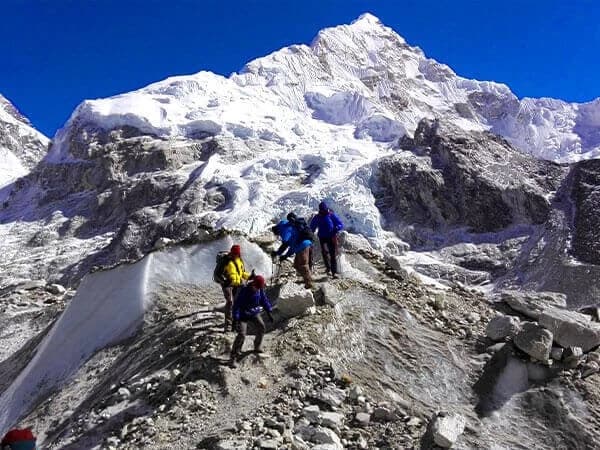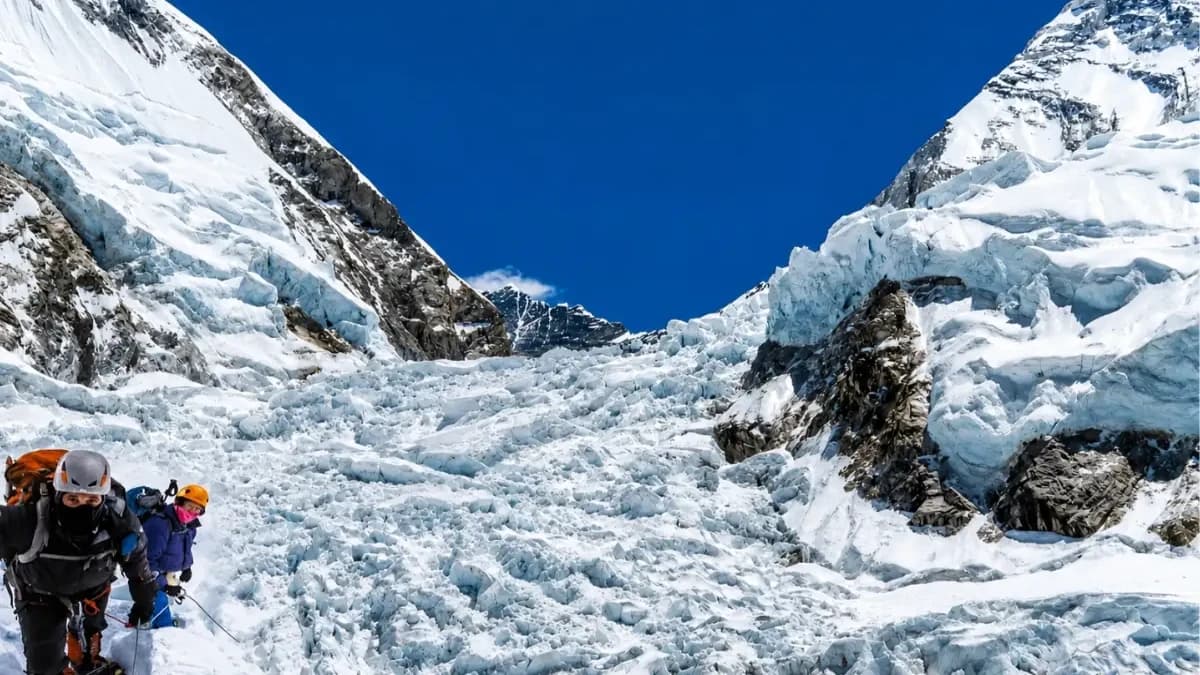
The Khumbu Icefall is the first and most dangerous barrier climbers face on their way to the summit of Mount Everest from the Nepal side. It’s renowned for its fast-changing ice towers, deep crevasses, and unstable ground and has the reputation of being the most unpredictable part of the mountain. Climbers need to carefully traverse this glacial maze every season with ladders, fixed ropes, and the experience of Sherpas.
For decades, the Khumbu Icefall has been one of the signature challenges of every Everest expedition. Mountaineers see it as a crucial test of skill, timing, and mental strength while trekkers admire its dramatic beauty from a safe distance. The glacier is constantly moving, so no two crossings are ever exactly the same.
This guide covers everything you need to know about the Khumbu Icefall, from how it forms and why it changes constantly to the risks, safety measures, and its role in every Everest expedition if you've ever wondered what it is, why it is considered so dangerous, or how climbers successfully cross it.
Quick Snapshot: Khumbu Icefall
|
Feature |
Details |
|
Location |
Between Everest Base Camp and Camp I on the South Col route, Nepal |
|
Elevation |
Approximately 5,400–5,900 m (17,717–19,357 ft) |
|
Length |
About 2 km (1.2 miles) |
|
Glacier Movement |
Moves around 0.9–1.2 m (3–4 ft) per day |
|
Main Hazards |
Serac collapse, deep crevasses, avalanches, unstable snow bridges |
|
Best Time to Cross |
Midnight to early morning (12:00–3:00 a.m.) |
|
Average Crossing Time |
2–12 hours, depending on experience and conditions |
|
Route Maintenance |
Managed each climbing season by the Icefall Doctors |
|
Who Can Enter? |
Permitted climbers and expedition teams only |
|
Best Viewpoints |
Everest Base Camp, Kala Patthar, and helicopter tours |
|
Best Seasons to Visit |
Spring (April–May) and Autumn (September–November) |
|
Why It's Famous |
The first and one of the most dangerous obstacles on the Nepal route to Mount Everest's summit |
Where Is the Khumbu Icefall?
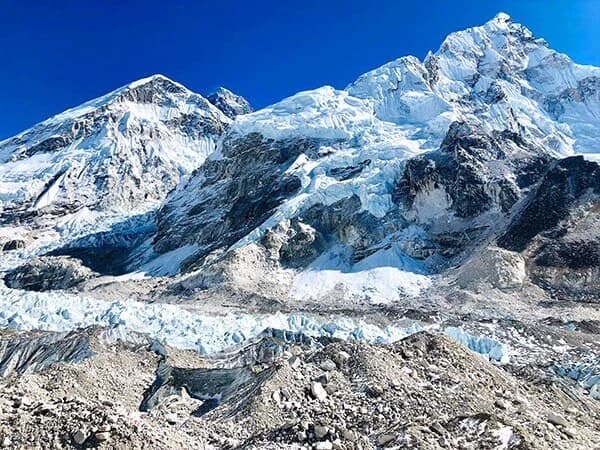
Khumbu Icefall is located in Sagarmatha National Park at the head of the Khumbu Glacier between Everest, Lhotse, and Nuptse. It is the first major challenge along the South Col route, starting just above Everest Base Camp (5,364 meters / 17,598 feet) and climbing to roughly 5,900–6,000 meters (19,357–19,685 feet) near Camp I.
The lower end of the icefall is only about a kilometer (0.62 miles) from Everest Base Camp and is easily visible from there. It is about 2 km (1.2 miles) long, starting at about 5900 m (19,357 feet) and finishing at about 5400 m (17,717 feet) near Base Camp. The Khumbu Icefall is located at approximately 27° 55′ 55.20″ North latitude and 86° 48′ 18.00″ East longitude.
It is the steepest section of the Khumbu Glacier and moves downhill about 1.2 meters (4 feet) every day. Ice that forms near the top of the glacier takes about 4.3 years to reach Everest Base Camp, creating constantly shifting ice towers, deep crevasses, and unstable ice blocks that make the Khumbu Icefall one of the most dangerous sections of an Everest expedition.
The Everest Base Camp Trek brings you to the foot of this legendary glacier without climbing Mount Everest. Explore the trail with experienced local guides.
How Deep Is the Khumbu Icefall?
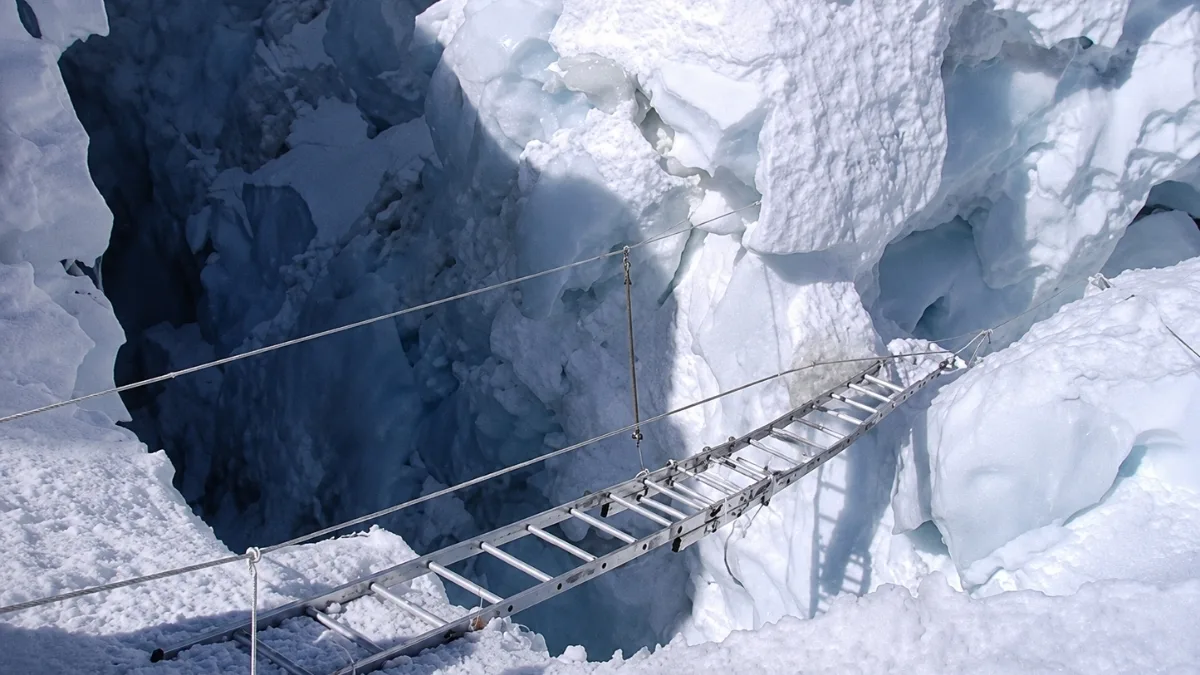
The Khumbu Icefall is constantly moving and changing, so its depth varies. In the upper part, the ice is generally 40 meters (131 feet) thick, while in the lower part, near Everest Base Camp, it is about 20 meters (66 feet) deep. The Khumbu Glacier inches its way downhill, so the ice cracks and shifts and settles, and the depth is never quite the same from one season to the next.
Massive crevasses, some more than 100 meters (328 feet) deep and 15 meters (49 feet) wide, also cut through the icefall. The first challenge on the route is the Khumbu Icefall, a glacier that is almost 2 kilometers (1.2 miles) long and several hundred meters wide.
The glacier is constantly changing, and so each climbing season the Icefall Doctors, the specialist team who look after the Everest climbing route, have to check and rebuild the safest route through the icefall and find out exactly how deep it is.
You might be interested to know: How Much Does It Cost To Climb Mount Everest?
Why Is the Khumbu Icefall So Dangerous?
The Khumbu Icefall is considered the most dangerous part of the Mount Everest climb, as it is ever-changing. Unlike solid rock, the glacier moves 0.9 to 1.2 meters (3-4 feet) per day, creating new cracks and collapsing old routes.
Ice towers called seracs can drop without warning, and deep crevasses require climbers to cross narrow aluminum ladders suspended over hundreds of feet of ice. As the glacier moves, what may be a safe path in the morning could be dangerous a few hours later.
Avalanches can also sweep down from the surrounding slopes into the icefall, particularly when warmer daytime temperatures weaken the ice and increase the danger. The Icefall Doctors rebuild the route with fixed ropes and ladders every climbing season, but the glacier is always shifting, so there is never an entirely safe route.
Most climbers will traverse the Icefall once or twice during an expedition, but Sherpa guides and load carriers can go through it 20 to 30 times in a season. So repeated exposure is one of the biggest reasons the Khumbu Icefall has one of the highest accident rates on Everest.
Crevasses Hidden Inside the Khumbu Icefall
The crevasses inside the icefall aren't small cracks you step over. Many run deeper than 100 meters, wide enough to swallow a climber and their gear whole. The dangerous ones aren't even the visible ones; they're the crevasses hidden beneath thin snow bridges that look completely solid until a climber's weight breaks through.
Crossing them means aluminum ladders, sometimes several tied end to end, balanced across the gap and anchored with rope. Walking one of these ladders in crampons, in the dark, with a heavy pack, tests nerve just as much as technique.
A single Khumbu Icefall serac looming above a crossing point only adds to the pressure, and climbers know that a Khumbu Icefall serac can shift position overnight without any visible signs.
Why is Midnight the Best Time to Cross the Khumbu Icefall?
The best time to cross the Khumbu Icefall is in the middle of the night, when the cold helps keep the glacier more stable. Most climbing teams depart Everest Base Camp between 12:00 a.m. and 3:00 a.m. to avoid the danger of serac collapses, widening crevasses and avalanches. The sun rises and the ice softens and moves faster and faster, and the trail gets more and more dangerous.
The crossing times depend on experience and acclimatization. Icefall Doctors and elite Sherpas usually take 2–3 hours Experienced climbers 3–6 hours First-time or less-acclimatized climbers: 8–12 hours. In high season, ladder crossings and fixed ropes can add considerable time, so an early start is important for safety and efficiency.
Why Do Climbers Cross the Khumbu Icefall Before Sunrise?
Climbers cross the Khumbu Icefall before sunrise, when night-time temperatures are colder and the glacier is more stable. Most expeditions depart from Everest Base Camp between midnight and 3 a.m., when the frozen ice is least likely to shift. This minimizes the hazards of serac falls, widening crevasses, and falling ice, making the route as safe as possible.
When the sun comes up, the glacier starts to melt and flow faster. Warmer temperatures weaken the ice, increase the likelihood of avalanches, and can loosen the anchors that hold fixed ropes and ladders in place. In view of these factors, parties of explorers will try to make the crossing in the early morning before conditions become noticeably more dangerous.
Want to explore the Everest region with confidence? From Everest Base Camp to custom Himalayan adventures, Nepal Gateway Trekking is here to help you every step of the journey.
The 2014 Tragedy That Changed Everything
On 18 April 2014, around 6:30 a.m., a massive serac broke loose from Everest's West Shoulder and triggered an avalanche that tore through the icefall. Sixteen Nepali climbers, all of them Sherpas preparing the route for the spring season, were killed. Only thirteen bodies were ever recovered. It remains the single deadliest Khumbu Icefall accident on record and reshaped how the route through the icefall gets planned and maintained to this day.
Deaths at Khumbu Icefall
The Himalayan Database records somewhere between 44 and 47 deaths in the icefall between 1953 and the mid-2020s. Before the 2014 avalanche, the icefall's darkest day was 5 April 1970, when six Sherpas died in a Khumbu Icefall accident while supporting a film crew documenting a ski descent of the mountain. Both events remain the two deadliest single Khumbu Icefall accident records in the mountain's climbing history.
Interestingly, some long-time Everest chroniclers argue the icefall isn't actually the single most lethal zone on the mountain once you compare the numbers against deaths above 8,000 meters in the Death Zone. What makes it feel more dangerous is that Khumbu Icefall accident events tend to happen suddenly and in clusters, rather than being spread thin across the whole climbing season.
Why Are Sherpas at Greater Risk in the Khumbu Icefall?
Sherpas’ greatest danger is in the Khumbu Icefall, where they spend much more time than anyone else on an Everest expedition. Most foreign climbers cross the icefall only 3-4 times in the course of acclimatization and their summit push, but Sherpa guides, rope-fixing teams, and load carriers may make 20-30 crossings in a single climbing season.
They transport oxygen cylinders, food, tents, climbing gear, and other essential supplies to the upper camps, often hauling heavy loads through one of the world’s most volatile environments.
Each time you cross the icefall, the chances of hitting collapsing seracs, hidden crevasses, avalanches, and constantly moving ice increase. This repeated exposure has led to Sherpas being the majority of the fatalities and injuries in the Khumbu Icefall.
But their ability, experience, and dedication enable the Everest expeditions to take place despite these risks. They establish and hold the climbing route on which every summit team relies.
How has the Khumbu Icefall changed Over Time?
In the last few decades, the Khumbu Glacier has thinned by an estimated 12-15 meters (39-49 feet) as temperatures have risen, and the resulting effect has changed the Khumbu Icefall considerably.
Everest Base Camp is now lower than it was when Mount Everest was first climbed in 1953, and the glacier is less stable due to warmer conditions. The seracs and crevasses are moving faster, and the weather patterns are less predictable, so guides and the icefall doctors have to monitor conditions more closely than they did before.
Today Mount Everest is more accessible due to better weather predictions, GPS, and route planning, but the Khumbu Icefall remains one of the most dangerous places on the mountain.
The glacier is still moving every day, ice towers can collapse without warning, and avalanches are an ever-present danger. From the relative safety of Everest Base Camp, the sheer ice walls are unforgettable.
The Khumbu Icefall is often described by climbers as a breathtaking and daunting sight, a place of immense beauty that demands respect and serves as a powerful reminder of the untamed power of the Himalayas.
Need Help? Our local trekking experts can recommend the perfect Everest itinerary based on your experience, fitness level, and travel goals.
The Beauty of the Khumbu Icefall: Nature's Frozen Masterpiece
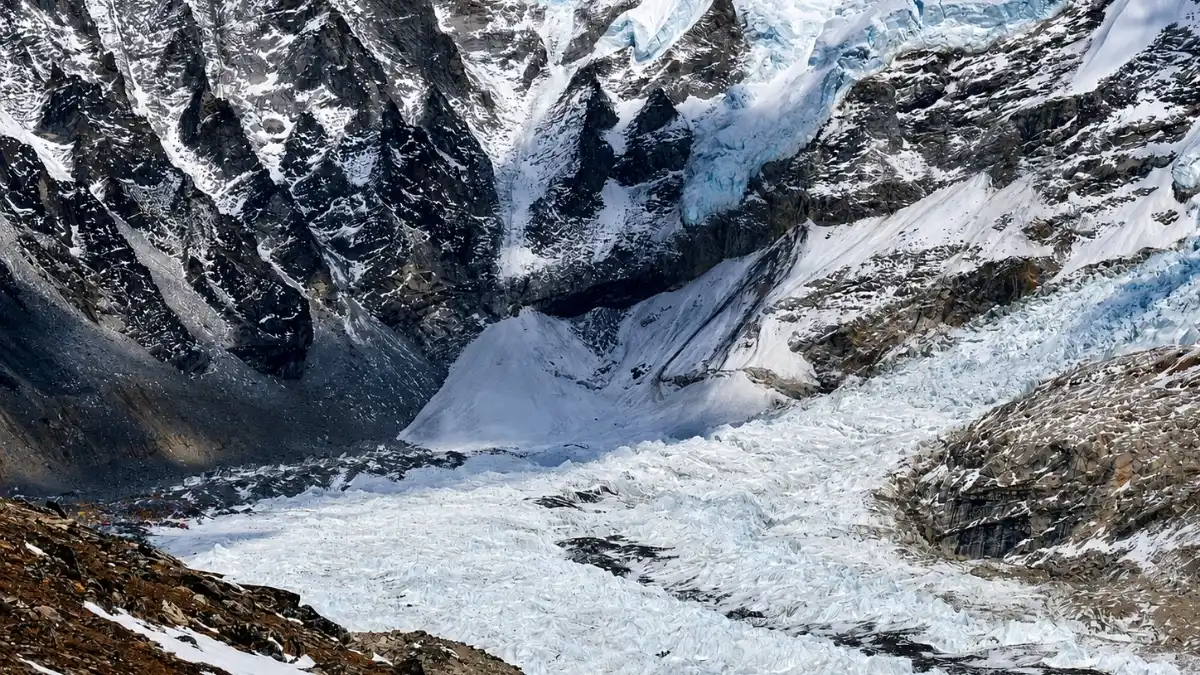
The Khumbu Icefall is one of the most spectacular natural wonders in the Everest area. Its towering blue ice seracs, deep crevasses, and shifting formations make for a dramatic landscape unlike anywhere else in the Himalayas. From Everest Base Camp or Kala Patthar, the icefall is an unforgettable memory of immense scale, rugged beauty, and a glacier that is always on the move.
The Khumbu Icefall is a stunning sight, but it is also one of the most perilous locations on Mount Everest. This is what makes it so unforgettable: the difference between beauty and danger. It is a powerful reminder of nature’s raw force for trekkers and a challenging gateway to the world’s highest summit for climbers.
Best Viewpoints for Seeing the Khumbu Icefall Without Climbing
You don't need a climbing permit to take in the Khumbu Icefall. A few reliable ways to see it:
From Everest Base Camp, you are close enough to spot ladders, fixed ropes, and seracs with the naked eye, and during the spring season you can pick out climbers moving through the lower sections with binoculars.
- From Kala Patthar (5,545 m), a short pre-dawn hike that delivers a sweeping panorama of the icefall against Everest's southwest face.
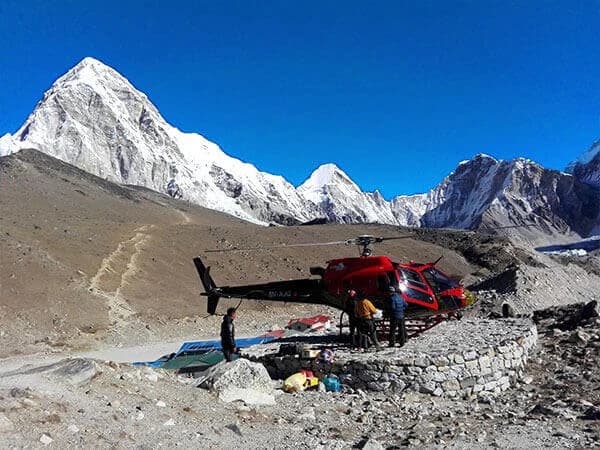
- Helicopter flights from Kathmandu or Lukla give an aerial view for travelers short on time.
- Spring (April–May) and autumn (September–November) offer the clearest skies and the best visibility for photos.
Wondering when to visit the Everest Region? Choosing the right season is crucial. Discover the best time for the Everest Panorama View Trek with clear mountain views, stable weather, and an unforgettable trek.
How Do Climbers Safely Cross the Khumbu Icefall?
Crossing the Khumbu Icefall is one of the most technically demanding parts of an Everest expedition. Because the glacier is constantly moving, climbers cannot rely on a permanent trail. Instead, they must use specialized equipment, follow strict safety procedures, and cross during the early morning hours when colder temperatures keep the ice more stable. Every step requires focus, teamwork, and guidance from experienced Sherpas.
To cross the Khumbu Icefall safely, climbers do the following:
- Start before sunrise: Most teams leave Everest Base Camp between midnight and 3:00 a.m. when the glacier is more stable.
- Use technical climbing gear: Climbers wear crampons, carry ice axes, and use ascenders, carabiners, and fixed ropes for safety.
- Cross ladders over crevasses: Aluminum ladders are placed across deep crevasses, requiring balance and careful footwork while wearing crampons.
- Be properly acclimatized: Climbers must adapt to the thin air and have the endurance to move safely above 5,000 meters (16,404 feet).
- Follow the Icefall Doctors' route: A specialized team of Sherpas installs and maintains ropes and ladders throughout the season, adjusting the route as the glacier shifts.
- Move efficiently and follow guides: Spending less time in the icefall reduces exposure to hazards such as collapsing seracs, avalanches, and falling ice.
Even with modern equipment and experienced guides, the Khumbu Icefall remains one of the most dangerous sections of Mount Everest. Safe crossings depend on preparation, discipline, and respecting the ever-changing nature of the glacier.
Final Thoughts
The Khumbu Icefall is more than just the first hurdle on the road to the summit of Mount Everest. It’s a glacier that’s constantly changing. One of the most remarkable and dangerous landscapes in the Himalayas is made up of massive seracs, deep crevasses, and moving ice. For climbers, it is the ultimate test of skill, preparation, and resolve. For trekkers, it is an unforgettable spectacle that shows the raw beauty and great power of nature.
From Everest Base Camp, Kala Patthar, or a helicopter flight, the Khumbu Icefall is an unforgettable spectacle. Its history, dangers, and strange geology make it one of the world’s most famous glaciers, and its fame is unsurprising. The Khumbu Icefall is the mythical gateway to the roof of the world, a place where beauty and peril co-exist.
Ready to Experience the Everest Region? Whether you're planning your first Himalayan trek or returning for another adventure, contact Nepal Gateway Trekking, which will help you choose the perfect Everest itinerary.
FAQs
Is it safe to walk toward the Khumbu Icefall from Base Camp?
Yes, it is safe to walk to the viewing area close to the Khumbu Icefall from Everest Base Camp, and this is a popular activity for trekkers. However, it is not safe to enter Khumbu Icefall per se, and only those who are permitted to climb and expedition teams are allowed to enter due to the constant threat of ice collapse, deep crevasses, and avalanches.
How do Sherpas manage so many repeated crossings?
Sherpas make repeated crossings through years of mountaineering experience, specialized training, and careful planning. They travel in the early morning when the glacier is more stable, use fixed ropes and ladders installed by the Icefall Doctors, and follow strict safety procedures. Even with these precautions, every crossing is a significant risk.
What gear do climbers use to cross the Khumbu Icefall?
Climbers need specialized mountaineering equipment to traverse the Khumbu Icefall safely. Climbers use a climbing harness, helmet, ascenders, a locking carabiner, crampons, an ice axe, and all other necessary gear. They also depend on fixed ropes and aluminum ladders, set up by the Icefall Doctors, to cross deep crevasses.
Is there an alternative route that avoids the Khumbu Icefall?
No. There is no commercial standard route that bypasses the Khumbu Icefall on the Nepal (South Col) side of Mount Everest. Alternative routes have been explored but are not commonly used. Climbers from the north (Tibetan) side avoid the Khumbu Icefall but face other technical obstacles higher on the mountain.
How deep is the Khumbu Icefall?
The Khumbu Icefall is generally about 20 m (66 ft) deep at its lower end and over 40 m (131 ft) deep near the top. Its crevasses are even deeper, with some reaching more than 100 meters (328 feet) into the glacier.
What is the Khumbu Icefall?
The Khumbu Icefall is the steepest and most broken part of the Khumbu Glacier, lying between Everest Base Camp and Camp I on the South Col route. It is made up of gigantic ice towers, deep crevasses, and constantly changing ice, and it is the first big challenge for climbers trying to reach the top of Mount Everest from Nepal.
Why is the Khumbu Icefall so dangerous?
The Khumbu Icefall is dangerous because the glacier moves 0.9–1.2 m (3–4 ft) per day, so the landscape is constantly changing. It is one of the most dangerous parts of any Mount Everest expedition, as it can contain collapsing seracs, deep crevasses, avalanches, and unstable snow bridges without warning.