Quick Answer
- Definition: Acclimatization is the biological process of adapting to decreased air pressure and reduced oxygen availability at high altitudes.
- The Golden Rule ("Climb High, Sleep Low"): Hike to a higher elevation during the day to trigger oxygen adaptation, then return to a lower sleeping altitude to rest.
- The 500-Meter Daily Rule: Above 3,000 m (9,843 ft), limit sleeping elevation gains to 500 m (1,640 ft) per day, taking a full acclimatization day every 1,000 m.
- Fitness Myth: Superior physical fitness does not prevent altitude sickness; ascent speed and time are the only controlling factors.
- Warning Signs & Action: Headache with nausea or fatigue indicates AMS (stop ascending); breathlessness at rest or loss of balance signals HAPE/HACE (descend immediately).
- Key Nepal Rest Stops: Standard high-altitude itineraries require dedicated acclimatization days in Namche Bazaar (3,440 m), Dingboche (4,410 m), Manang (3,519 m), or Samagaun (3,530 m).
Acclimatization is how your body copes with less oxygen as you climb. On a trek, you support it by gaining height slowly, taking planned rest days, and sleeping lower than your highest point. Do that, and you walk stronger and lower your risk of altitude sickness.
You’ve booked a high-altitude trek, and your training is going well. Then a friend asks if you’ve planned your acclimatization, and you realize you’re not sure what is acclimatization beyond “going up slowly.”
On a trek, it matters more than fitness, gear, or itinerary. It’s often the difference between enjoying day six and turning back on day four.
This guide covers how it works, what to do on the trail, what rest days are really for, and where they fall on popular Nepal routes. It also covers the warning signs to watch for.
What Does Acclimatization Mean?
Acclimatization is your body's gradual adjustment to lower oxygen pressure at high altitude. The percentage of oxygen in the air stays around 21%, but atmospheric pressure drops as you climb. This means less oxygen is available with each breath, so your body must adjust to keep supplying oxygen to your organs and muscles.
In simple terms, a few things change:
- You breathe faster and deeper
- Your heart beats faster, even at rest
- Your body slowly makes more red blood cells
None of this happens on command. It takes days, not hours, and no amount of gym training lets you skip it.
You’ll also see it spelled acclimatisation. It’s the same thing, just the British spelling.
What Are the 3 Stages of Acclimatization to High Altitude?

Your body doesn’t adjust to high altitude all at once. The process can be broken into three overlapping stages, and each one runs on its own clock.
|
Stage |
Timeframe |
What your body does |
|
1. Immediate response |
First hours |
Breathing increases, and your heart rate may rise. |
|
2. Early acclimatization |
First several days |
Your kidneys adjust bicarbonate levels, helping your body sustain increased breathing. |
|
3. Longer-term adaptation |
Days to weeks and beyond |
Increased red blood cell production and other changes help improve oxygen transport. |
Stage 1: Immediate Response (First Hours)
As soon as you gain altitude, your body responds to lower oxygen pressure. You breathe faster and deeper, and your heart rate may rise, even at rest. Breathing harder during uphill walking can be normal, especially as you adjust to the altitude and effort. However, a headache, nausea, dizziness or unusual fatigue after ascent can indicate altitude illness. Tell your guide if you feel unwell.
Stage 2: Early Acclimatization (First Few Days)
Your kidneys remove bicarbonate to help balance your blood chemistry, allowing your body to maintain increased breathing. Your kidneys also help regulate the body's response to altitude through changes in acid-base balance. During the following days, your body continues adjusting to the lower oxygen pressure, although sleep may remain disturbed.
These changes take time, which is why gradual ascent and planned acclimatization stops matter. Climbing higher before your body has adjusted can increase the risk of altitude sickness.
Stage 3: Long-Term Adaptation (Weeks)
Over the following days and weeks, increased red blood cell production and other physiological changes help your body transport and use oxygen more effectively. A typical two-week trek allows only part of this longer-term adaptation to develop, so your early ascent schedule remains particularly important.
Acclimatization does not restore sea-level performance. Even a well-acclimatized trekker will usually walk more slowly at 4,500 m (14,764 ft) than at 1,500 m (4,921 ft). Above roughly 5,500 m (18,045 ft), the body's ability to adapt becomes increasingly limited.
Your body continues adjusting throughout a trek, but each increase in sleeping altitude adds further strain. Feeling well at 3,500 m (11,483 ft) does not guarantee that you will feel well at 4,400 m (14,436 ft).
Why Does Acclimatization at High Altitude Matter?
Altitude sickness can occur when you ascend to around 2,500 m (8,202 ft) or higher, although individual risk varies and illness can occur at lower elevations. Many Nepal treks cross this altitude early in the itinerary.
A flight into Lukla (about 2,840 m or 9,318 ft) puts you above this level on day one, so allow time to adjust rather than starting with a demanding trek.
Even a short route like the Ghorepani Poon Hill Trek, which reaches about 3,200 m (10,499 ft), climbs past it.
Fitness doesn’t protect you here. Marathon runners get sick, and so do experienced hikers who rush. Acclimatization at high altitude comes down to time, not fitness.
|
Where you’ll be |
Altitude |
Approximate oxygen pressure relative to sea level |
|
Sea level |
0 m ( 0 ft) |
100% |
|
Namche Bazaar, Manang |
3,440–3,519 m (11,286–11,545 ft) |
64% |
|
Dingboche |
4,410 m (14,469 ft) |
57% |
|
Everest Base Camp, Thorong La |
5,364–5,416 m (17,598–17,769 ft) |
About 50% |
Namche Bazaar sits close to the 3,500 m (11,483 ft) row. Everest Base Camp sits above 5,000 m (16,404 ft), where atmospheric pressure is roughly half of sea-level pressure. Although oxygen still makes up about 21% of the air, each breath provides less oxygen because the overall pressure is lower.
How Long Does It Take to Acclimatize?
To acclimatize to each new sleeping height, most people need 1 to 3 days (24 to 72 hours). Deeper changes, like extra red blood cells, take several days to weeks.
How Does the Acclimatization Process Work?
The acclimatization process doesn’t happen all at once. Your body continually adapts to lower oxygen levels over time, even as you gain elevation. However, ascending too quickly overrides this process and dramatically increases your risk of altitude sickness. Feeling comfortable at one altitude does not mean you are fully adjusted to the next.
There’s also a limit to how well your body can adapt. Above roughly 5,500 m (18,045 ft), long-term acclimatization becomes increasingly difficult, and the body cannot fully adapt to the extreme altitude. Even a well-acclimatized trekker will walk more slowly at 4,500 m (14,764 ft) than at 1,500 m (4,921 ft).
How to Acclimatize to High Altitude: 4 Practical Tips
There’s no secret trick. A few habits do almost all the work, and most of them are about patience.
1. Follow the 500 m Rule
Above 3,000 m (9,843 ft), a commonly used guideline is to increase sleeping altitude by no more than about 500 m (1,640 ft) per day, with an additional acclimatization day for every 1,000 m (3,281 ft) gained. This is a general guideline, not a guarantee against altitude sickness. Your overall ascent profile and individual response to altitude still matter.
|
Night |
Sleeping height |
Note |
|
1 |
3,000 m (9,843 ft) |
Start of the high section |
|
2 |
3,500 m (11,483 ft) |
+500 m (+1,640 ft) |
|
3 |
4,000 m (13,123 ft) |
+500 m (+1,640 ft) |
|
4 |
4,000 m (13,123 ft) |
Rest night: short hike, then back down |
|
5 |
4,400 m (14,436 ft) |
A smaller step, which is fine |
Sleeping altitude counts for more than the highest point you reach in a day. You can hike to 5,000 m (16,404 ft) and be fine if you sleep at 4,400 m (14,436 ft). So when you compare treks, check the sleeping height for each night, not just the number of days.
2. Drink, Eat, and Skip Alcohol
Dry air and faster breathing can increase fluid loss. Drink regularly according to your activity level and conditions, including fluids such as tea and soup. Avoid forcing yourself to drink excessive amounts of water, as overhydration can be harmful. Staying hydrated supports your wellbeing but does not prevent altitude sickness.
Eat even when your appetite drops. Dal bhat, rice, potatoes, and noodles are easy to digest. Skip alcohol and sleeping pills, because both slow your breathing at night.
3. Walk Slower Than You Think You Need To
Pace is one of the few things you fully control. A simple check is the talk test: you should be able to hold a conversation while walking. If you can’t, slow down.
Short, regular breaks help more than one long stop. Take small steps on steep sections and match your breathing to your steps.
The people who zoom past you on day three are often the ones struggling by day six. You’re not racing anyone, and the trek is the same length for everyone.
4. Tell Your Guide Early
A mild headache is easy to hide, and that’s the problem. Altitude sickness usually starts small, with a headache, a bit of nausea, dizziness, or unusual tiredness. Caught early, it often just means an extra rest or a night at the same height.
Waiting until it’s bad makes everything harder. A good guide would much rather hear about a small symptom on day four than deal with a serious one on day six.
If you want one line on how to prevent altitude sickness, it’s this: go up slowly, rest on schedule, and speak up early.
Acclimatization in Trekking: Popular Nepal Routes
Acclimatization in trekking works best when rest days are built in from day one. Every route has its own rhythm, so here’s where they usually fall on popular treks. The hikes are typical examples, and your itinerary may differ.
|
Trek |
Rest-day stop |
Altitude |
Typical hike |
|
Namche Bazaar |
3,440 m (11,286 ft) |
Everest View Hotel (3,880 m (12,730 ft)) |
|
|
Everest Base Camp |
Dingboche |
4,410 m (14,469 ft) |
Toward Nangkartshang Peak |
|
Manang |
3,519 m (11,545 ft) |
Gangapurna Lake or Ice Lake |
|
|
Samagaun |
3,530 m (11,581 ft) |
Birendra Lake, Pungyen Gompa, or Manaslu Base Camp |
|
|
Kyanjin Gompa |
3,870 m (12,697 ft) |
Kyanjin Ri or Tserko Ri |
Everest Base Camp Acclimatization
Most itineraries build in two acclimatization stops: Namche Bazaar and Dingboche.
The flight into Lukla (about 2,840 m (9,318 ft)) already puts you above the 2,500 m (8,202 ft) mark, so keep the first day easy.
At Namche, hike up to Everest View Hotel and come back down. At Dingboche, walk toward Nangkartshang Peak and return to sleep. That’s climbing high and sleeping low in real life.
If you’d rather stay lower, the Everest Panorama View Trek is a shorter route at lower heights, and the Gokyo Lake with Everest Base Camp Trek spreads the climb over more days.
Annapurna Circuit Acclimatization
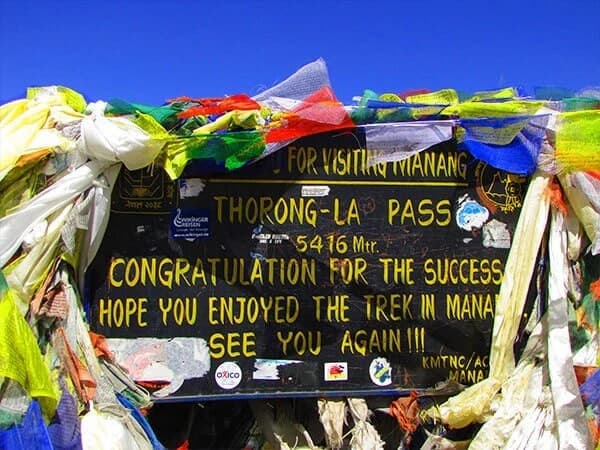
The big challenge is Thorong La Pass at 5,416 m (17,769 ft), so how you use Manang matters. Most trekkers take an extra night there and do a day hike above the village.
Ice Lake is a long, steep day, so go slowly. If you’re feeling off, Gangapurna Lake is the easier choice. Don’t treat the extra night as optional.
Some itineraries add a side trip to Tilicho Lake from Manang, as does our Annapurna Circuit Trek with Tilicho Lake.
Manaslu Circuit Acclimatization
Manaslu is remote, and help can be far away, so a slow, steady schedule matters even more. Most groups rest at Samagaun and take a side hike to Birendra Lake or Manaslu Base Camp.
Some add a stop at Samdo (3,875 m (12,713 ft)) before Larkya La (5,106 m (16,752 ft)) to give slower adjusters more time.
Planning one of these routes? See the treks we run at Nepal Gateway Trekking and how we build rest days into each itinerary.
Altitude Sickness: AMS, HAPE and HACE
Acute mountain sickness (AMS) is the mildest and most common form of high-altitude illness. It usually starts 6 to 24 hours after reaching a new height. HAPE (fluid in the lungs) and HACE (swelling of the brain) are rare but serious.
These are the altitude sickness symptoms to watch for:
|
Condition |
Warning signs |
What to do |
|
AMS |
Headache with nausea, dizziness, unusual tiredness or other symptoms |
Stop ascending and tell your guide. If symptoms worsen or become severe, descend and seek medical help. |
|
HAPE |
Unusual breathlessness during activity, worsening exercise ability, cough or breathlessness at rest |
Treat as an emergency. Arrange urgent assisted descent and medical care. |
|
HACE |
Confusion, loss of balance, difficulty walking straight or altered consciousness |
Treat as an emergency. Arrange urgent assisted descent and medical care. |
Never continue ascending when you have symptoms of altitude sickness. Worsening symptoms or signs of HAPE or HACE require urgent medical attention and descent with assistance. Do not rely on rest or hydration alone to treat a serious altitude illness.
For additional guidance on recognizing, preventing, and treating altitude illness, consult the CDC Yellow Book's high-altitude travel guidance. Seek advice from a qualified healthcare professional before your trek if you have concerns about altitude illness or preventive medication.
Diamox for Altitude Sickness
Diamox (acetazolamide) is the medicine most often used to help prevent AMS. It can cause tingling in the fingers and lips, and it isn’t right for everyone. Talk to your doctor before the trip, and never use it to climb faster than the schedule allows.
Final Thoughts
Most trekkers who get into trouble at altitude didn’t do anything dramatic. They just went a little too fast, skipped a rest day, or brushed off a headache.
So, what is acclimatization in the end? It’s giving your body time to catch up with the height before you climb higher. The good news is that learning how to acclimatize to high altitude isn’t complicated.
Walk slowly, sleep lower than your highest point when you can, drink and eat regularly, and tell your guide how you feel.
When you’re choosing a high altitude trek, look at the sleeping height for each night and where the rest days fall. An itinerary with a spare day or two is usually the better one. Check, too, that your travel insurance covers the heights you’ll reach and emergency evacuation.
Want an itinerary with the rest days already built in? Contact Nepal Gateway Trekking and we’ll plan a route with safe sleeping heights and spare days for your pace.
Frequently Asked Questions
How long does it take to acclimatize?
Most people need one to three days to adjust to a new height. Deeper changes, like more red blood cells, take weeks. Everyone differs, so build rest days into the plan.
At what altitude does altitude sickness start?
Usually above about 2,500 m (8,202 ft). It can happen lower, but that’s uncommon. Above 3,000 m (9,843 ft), climbing too fast raises the risk quickly.
What is an acclimatization day?
It’s a planned extra night in the same village, like Namche Bazaar or Manang. You take an easy hike a few hundred meters higher, then return to sleep at the same lodge.
What does “climb high, sleep low” mean?
You hike higher during the day, then come back down to sleep. Your body gets a taste of thinner air without spending the night in it.
Can fit people get altitude sickness?
Yes. Fitness doesn’t predict who gets sick. The main risk is climbing too fast, and fit trekkers often do exactly that.
Can you skip an acclimatization day?
It’s not a good idea. Feeling fine that day proves little, because symptoms often show up that night. If time is tight, choose a longer itinerary.
Does Diamox replace acclimatization?
No. Diamox can lower your risk for some people, but it doesn’t replace a slow climb and rest days. Ask your doctor well before the trip.
What is the difference between acclimatization and acclimation?
Acclimatization is adjusting to a natural environment, like altitude. Acclimation usually means adjusting to one changed factor, often in a lab. For trekking, acclimatization is the word you’ll see.